




Is Your E-Commerce Website Ready for AI Shopping Agents?
Consumers are letting AI do their shopping research. Find out how to shit from SEO to GEO and ensure your e-commerce products are cited by AI assistants.
This year in e-commerce has been all about Artificial Intelligence. The greatest players in the game, such as Google and OpenAI, have been going back and forth with their approaches to the newly built agentic commerce world. Truth is, it is a new and undiscovered area, for the consumer as much as it is for these AI giants.
Based on these past months of trial and error, two things became quite clear. While consumers may not yet be ready for completely autonomous agentic commerce, they are certainly ready to let AI do their research for them. Consumers want assistance, but they still desire the final click. Conversely, the technology is advancing so rapidly that the gap between research and autonomous purchasing is shrinking by the day.
For Chief Marketing Officers and e-commerce leaders, this represents a major shift in approach. For the past decade, your marketing budget has been primarily focused on human psychology. You have been capturing attention with beautiful imagery, writing persuasive copy, and optimising the checkout flow for a human finger tapping on a glass screen. Yet, what happens when the entity making the purchasing decision does not have eyes, or emotions?
Today, your website is being increasingly visited by AI.
In fact, according to Adobe’s latest quarterly report for 2026, when it comes to using AI for research, retail has had the strongest AI traffic boost of all industries, with 39% of consumers having used different AI assistants when shopping online [1]. Furthermore, 17% of all online orders during the holiday season are now influenced by AI recommendations [17]. What is more, 85% of those who have been using AI for these purposes say it improves their overall shopping experience [1]. So it's not just about using it, AI is actually helping, which does not come as a surprise.
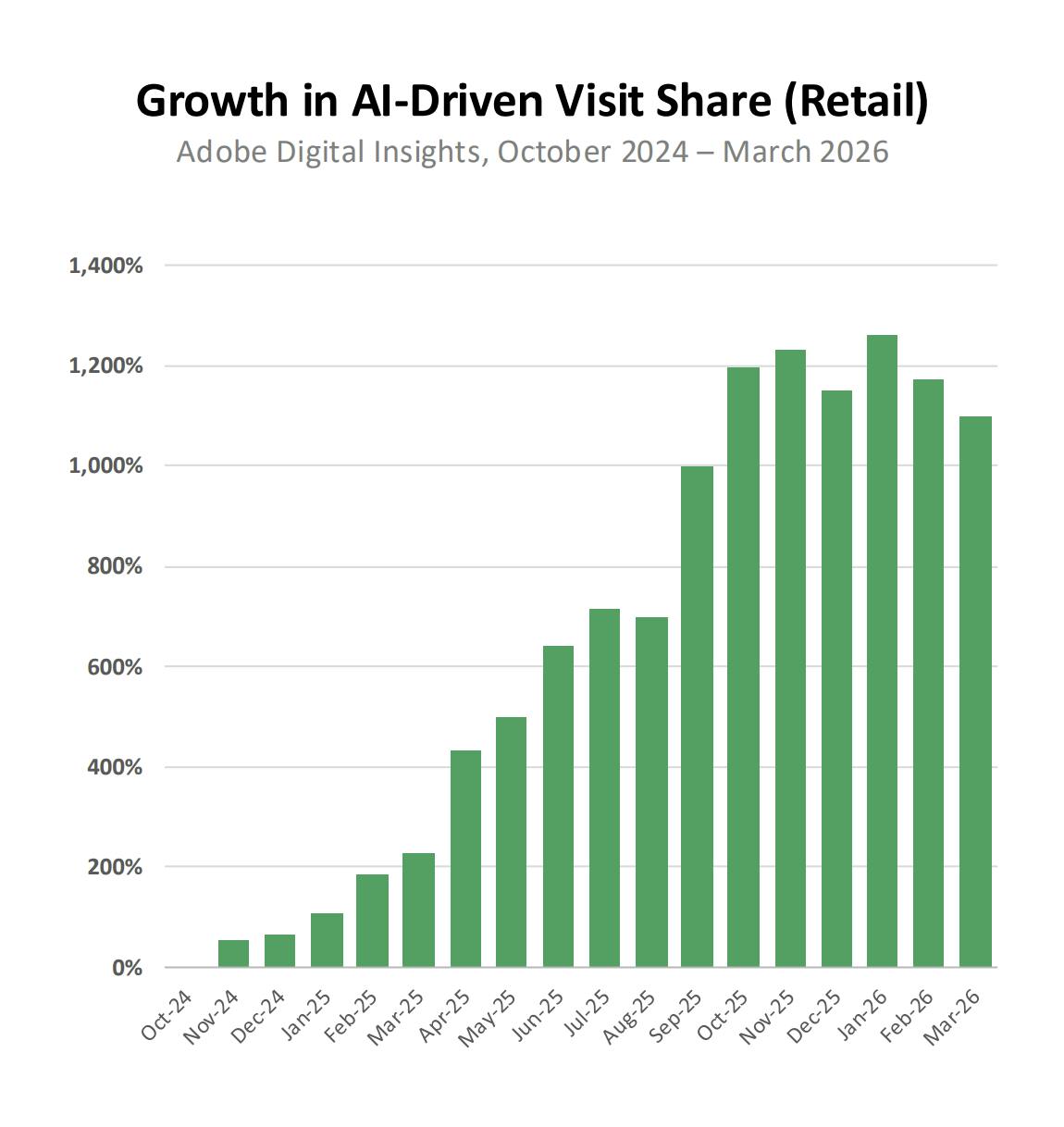
Image 1: AI visits growth in Retail, Source: Adobe 2026 Report
It is now increasingly AI that is finding, visiting, comparing, evaluating, and recommending your products.
With such large numbers of your target audience starting their shopping journeys with AI, it is crucial for you to prepare your website for those AI visits.
Website Speed Requirements for AI Crawlers and APIs
The AI evaluates your website in seconds.
The importance of website speed has been highlighted for years with a human user in mind. The human visitor of your website has little to no patience for your website loading slowly. As page load time goes from 1 second to 3 seconds, the probability of a bounce increases by 32% [18].
In other words, your website is expected to load in under 3 seconds, ideally in less than 2 seconds. Every additional second drastically increases bounce rates, sending your target audience straight to your competition.
However, when we talk about AI shopping agents, the concept of speed takes on an entirely new meaning.
An AI agent crawling your site via API or scraping your front-end does not wait for large, unoptimised hero images or heavy JavaScript animations to load. Large Language Models operate on strict processing timelines. If your website server response time is sluggish, or if your backend architecture is bloated, the AI will simply time out and abandon the crawl. If it doesn't crawl your website, you have no chance of being recommended in its answers. In other words, you do not exist.
On the other hand, a lightning-fast infrastructure guarantees that your entire product catalogue is indexed seamlessly.
This is where backend web engineering becomes a front-line marketing strategy. To satisfy both human impatience and algorithmic efficiency, a recommended approach is moving away from heavy client-side scripts. By implementing Server-Side tracking, you can drastically reduce the amount of code loading in the user browser. This not only makes your website exceptionally fast and highly secure, but it presents a clean, immediately accessible layer of data to any AI agent trying to read your catalogue.
It is also vital you track and understand Core Web Vitals, which will tell you all you need to know about your website speed so you can communicate it to your development team.

Image 2: Core Web Vitals, Source: Nitrogen Platform
Generative Engine Optimisation (GEO) vs Traditional SEO
While the experts are still discussing whether GEO (Generative Engine Optimisation) is just traditional SEO under a new name, the fact of the matter is that optimising your website now includes new techniques. Your ultimate goal has been updated alongside the changed approach of your target audience.
If they are shopping by starting their research through AI, that is exactly where you need to be.
In traditional SEO, the goal was broad visibility. Ranking fourth, fifth, or even eighth on a Search Engine Results Page still guaranteed a certain percentage of click-through traffic. Consumers would open multiple tabs, browse your site, look at your competitors, and make a deliberate choice.
In GEO, the paradigm is entirely different. The AI synthesises one distinct answer. You are either cited as the top recommendation, or you are invisible. There is no page two in a ChatGPT or Gemini response.
To win in a GEO landscape, your brand must transition from competing for keywords to competing for citation likelihood. When a user asks an AI to find a sustainable, waterproof running shoe under £130 that can be delivered to London by Thursday, the AI runs a complex filtering process in milliseconds. It cross-references pricing, reviews, shipping policies, and technical specifications. If your website infrastructure cannot feed this exact data to the AI seamlessly, you lose the sale to a competitor who can.
There is a whole list of what needs to be done if you want to be that one recommendation an LLM provides. You also need to diversify, meaning you cannot focus on a single LLM, but rather aim at being recommended by all. This is important to highlight as all these different models function differently when deciding what their answer will be. For example, only 11% of answers between ChatGPT and Perplexity can be matched [20].
Machine-Readable Content and Structured Data
If an AI is reading your page, it means that poetically constructed product descriptions or other creative website copy are irrelevant. The AI cannot appreciate emotional storytelling. Instead, it requires hard facts.
This brings us to the crucial concept of factual density. AI shopping agents look for structured data, verified specifications, clear bullet points, and precise measurements to be able to precisely answer their users’ questions and prompts. If an AI agent has to guess whether your product fits a user's exact parameters, it will simply skip your brand as hallucinations and mistrust are major issues they are trying to avoid and resolve. By contrast, a brand that explicitly lists every technical detail will win the AI recommendation every single time.
Consider a standard e-commerce product page for a winter coat. A human-focused description might talk about wrapping yourself in the ultimate cosy embrace this winter, describing the jacket as a warm hug perfect for chilly city nights.
An AI agent reads that and learns absolutely nothing. It needs to know specific details:
- Insulation type: 800-fill goose down.
- Waterproof rating: 10,000mm.
- Care instructions: Machine wash cold.
- Inventory status: In stock, 4 items left in size Medium.
To bridge this gap, your website must be fluent in structured data, specifically JSON-LD schema markup. This acts as a universal translator, taking your beautiful, human-readable website and turning it into a hyper-organised database that an AI can instantly comprehend.
This is not a task for a copywriter. It is a highly technical task for modern web engineering. By structurally organising your catalogue data, you ensure that when an AI evaluates your product against a competitor, your product wins on clarity and factual density alone.
Deploying AI On-Site Search for E-commerce
If you wish to go a step further, you can offer an optimal customer experience directly on your website. Do not wait for AI to visit your website from the outside. Instead, create your own AI, using conversational AI to help your visitors find exactly what they need immediately.
Traditional keyword search is fundamentally broken. Consumers have been trained to type disjointed keywords like "dress blue summer cheap" because they know standard e-commerce search bars are too rigid to understand normal human language. Yet, statistics show that up to 69% of shoppers go straight to the search bar when visiting an e-commerce site [19]. And those search bars are, in most cases, not functional. At least not functional in the way the user wants them to be: conversational. Consumer expectations have shifted dramatically. Today’s shoppers expect your brand to understand intent, context, and nuance.
Let’s compare these two major brands and examples of impressively large product catalogues: ASOS and Zalando.
Examples of AI On-Site Search in Action
ASOS Menus and Filters
While ASOS is using AI to tackle a different e-commerce challenge entirely, addressing the disconnect between buying a single item and building a complete look, their product catalogue is still quite difficult to navigate.
They favour a traditional approach: multiple-step menus and detailed filters. An approach that may have worked a couple years ago, but one that does not work for the modern consumer who is not interested in clicking through all the filters, setting up the price range, colour, size, etc.
Zalando AI Styling Assistant
Zalando has transformed its search experience from a basic retrieval tool into a consultative styling assistant. Powered by advanced AI models, their localised fashion assistant allows customers to bypass traditional category filters entirely. A shopper can simply type a natural question asking what they should wear for a wedding in Santorini in July.
A traditional search bar would return zero results for this query.
Conversely, the Zalando AI instantly parses the context of formal attire, the hot weather requiring breathable fabrics, and the bright Mediterranean location. It then curates a highly specific, personalised selection of outfits. By turning passive browsing into an active, intelligent conversation, Zalando solves the paradox of choice for the consumer. This frictionless experience has revolutionised their engagement metrics, creating a shopping environment where the user feels deeply understood.
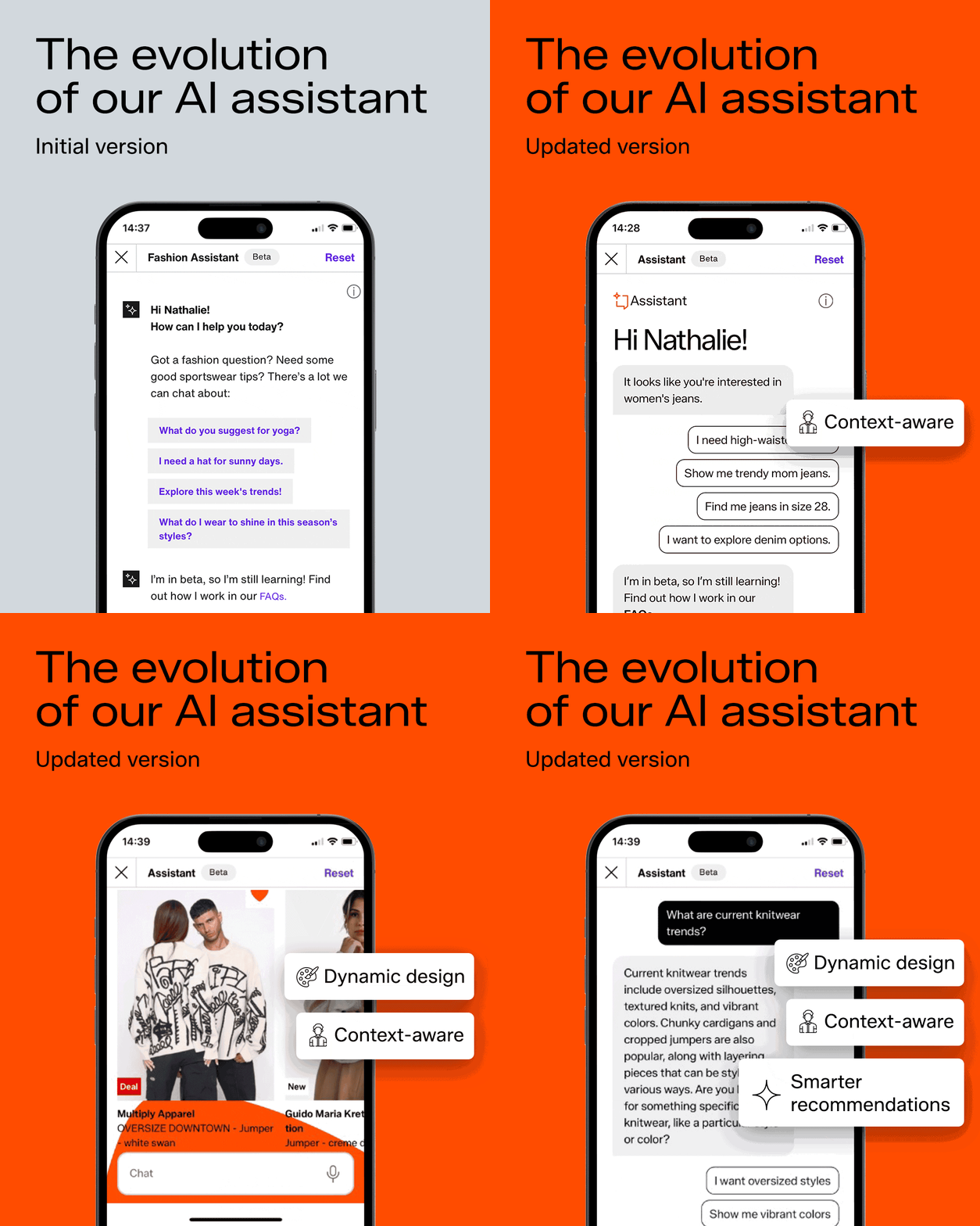
Image 3: Zalando Assistant
The Role of First-Party Data in AI Commerce
While implementing conversational commerce and AI search sounds incredibly appealing, it cannot function without a flawless data foundation. An AI agent is truly only as intelligent as the data it is fed.
If your website relies on outdated client-side tracking pixels that are constantly blocked by modern ad-blockers and privacy updates, your AI tools are flying blind. They cannot personalise the experience if they do not know who the user is or what they have previously browsed. On the other hand, brands that control their own data pipeline can serve highly accurate, individualised AI experiences.
This is exactly why upgrading your tracking infrastructure is the invisible prerequisite to AI readiness. Once again, we go back to the importance of implementing Server-Side GTM. Implementing Server-Side Google Tag Manager (GTM) ensures that your first-party data is collected securely, accurately, and rapidly, completely bypassing browser-level restrictions. It provides your AI systems with the clean, rich data they need to make accurate decisions in real-time. Whether you are using product recommendation engines, conversational search bars, or dynamic pricing algorithms, server-side architecture is the required engine driving it all.
Auditing Your Website for AI Shopping Agents
The shift toward agentic commerce is not a distant, theoretical future. It is happening right now, reshaping the digital high street. Every single day your website relies solely on traditional search, slow front-end architecture, and human-only navigation is a day you are losing market share to competitors who speak the language of algorithms.
Preparing for this shift requires a dual approach. First, you must ensure your technical foundation is absolutely flawless. This means achieving lightning-fast load times, establishing server-side data tracking, and deploying structured, machine-readable catalogues to conquer GEO. Second, you must bring the power of AI to your own storefront, deploying conversational commerce tools that guide your customers from intent to purchase with zero friction.
Achieving this requires significantly more than a standard marketing agency. It requires deep, dedicated technical expertise.
The AI shoppers have already arrived. The only question left is whether they can actually read your website.
We at Firney can help you get started on this path by auditing your website, pinpointing places for improvement and giving you the exact plan for your growth in the agentic commerce era.
FAQ
Frequently Asked Questions
References
[1] Quarterly AI Traffic Report: Q2 2026 ADI AI Sourced Traffic Insights - Adobe Inc. https://business.adobe.com/resources/sdk/.2026-q2-ai-traffic-report/q2-2026-adi-ai-sourced-traffic-insights.pdf [2] Milliseconds Make Millions: The impact of mobile site speed on brands - Google / Deloitte https://www2.deloitte.com/ie/en/pages/consulting/articles/milliseconds-make-millions.html
[3] Zalando boosts the customer experience with its Assistant, powered by GPT‑4o mini - OpenAI https://openai.com/index/zalando/
[4] How ASOS is using Artificial Intelligence for Styling - Vogue Business https://www.voguebusiness.com/technology/asos-artificial-intelligence-styling
[5] Product Structured Data Guidelines - Schema.org https://schema.org/Product
[6] Generative Engine Optimization (GEO): The Future of Search - Search Engine Journal https://www.searchenginejournal.com/generative-engine-optimization/
[7] Fixing Website Speed to Secure AI Search Visibility - Firney https://www.firney.com/news-and-insights/fixing-website-speed-to-secure-ai-search-visibility
[8] Page Speed Statistics 2026: Performance and Revenue Impact - Digital Applied https://www.digitalapplied.com/blog/page-speed-statistics-2026-revenue-impact
[9] Lessons Learned From Adobe's 2026 Q2 AI Traffic Report - No Hacks https://nohacks.co/blog/lessons-learned-adobe-ai-traffic-report
[10] AI traffic grows but retail sites lag in AI search visibility - Adobe for Business https://business.adobe.com/blog/ai-traffic-surge-retail-sites-not-machine-readable
[11] Scaling inspiration: how Zalando is rebuilding fashion & lifestyle content with AI - Empathy Lab https://www.empathylab.com/en/news-and-insights/scaling-inspiration-how-zalando-is-rebuilding-fashion-and-lifestyle-content-with-ai
[12] Server-Side Tagging: The Future of First-Party Data - MeasureSchool https://measureschool.com/server-side-tagging/
[13] Agentic Commerce: How AI is Rewriting the Rules of Retail - McKinsey & Company https://www.mckinsey.com/capabilities/quantumblack/our-insights/the-future-of-ai-in-retail
[14] Why Factual Density is the Key to LLM Legibility - Towards Data Science https://towardsdatascience.com/factual-density-and-llms/
[15] The Paradox of Choice in E-commerce and How AI Solves It - Nielsen Norman Group https://www.nngroup.com/articles/paradox-of-choice/
[16] Firney: AI and Web Engineering Solutions for E-commerce - Firney https://firney.com/
[17] Holiday Shopping Report: AI Influences 17% of Global Purchases - Salesforce https://www.salesforce.com/blog/holiday-shopping-report/
[18] Find out how you stack up to new industry benchmarks for mobile page speed - Think with Google https://www.thinkwithgoogle.com/marketing-strategies/app-and-mobile/mobile-page-speed-new-industry-benchmarks/
[19] E-Commerce Site Search Statistics - Algolia https://www.algolia.com/blog/ecommerce/site-search-statistics/
[20] AI Search Engines Overlap Study: ChatGPT vs. Perplexity - SE Ranking https://seranking.com/blog/ai-search-engines-study/