




Server-Side GTM: CMO's Data Imperative
Ad blockers and privacy updates are killing attribution. Discover why client-side tracking fails in 2026 and how server-side GTM recovers lost conversions, data accuracy, and site speed.
In 2026, relying on standard browser-based analytics means you could be missing 15-30% of your actual conversions.
This is not a new trend. Every day you remain relying on incomplete data is another day of wasted time and budget. While you may have invested in a perfect marketing campaign, the results in your tracking data could lead you to question all your efforts. You might think something was wrong and make future decisions based on incorrect numbers.
With a “poorly functioning” campaign, the reality is often different. It is not necessarily your ROAS that is down. It could simply be your visibility. Simply, because there is a simple solution that does not require you to restart your campaign from scratch, just change your approach.
The Old Visibility
As we’ve mentioned, this drop in online visibility is not new. However, the data gap has grown significantly in recent years. We can categorise your “data killers” into three main sections.
1. Ad Blockers
While as users we may feel ad blockers are just simple browser extensions, the technology is now far more aggressive and far more damaging for the side trying to learn something from every user visit. By late 2025, global ad blocker penetration reached 42.7%, with even higher rates among the tech-savvy demographics you likely target.
These tools do not just hide banner ads, as their name might suggest. They stop the tracking scripts your analytics rely on from ever loading. This means nearly half of your audience could be visiting your site and purchasing while your dashboard reports zero traffic. You can easily spot the problem now.
2. Cookie Changes
Browser privacy updates have dismantled the 30-day attribution window marketers used to rely on. The landscape in 2026 is fragmented and hostile to traditional tracking.
Safari and iOS (Intelligent Tracking Prevention)
Apple continues to limit cookie lifespans for client-side trackers to just 24 hours. If a user clicks an ad on Monday but buys on Wednesday, you lose the attribution entirely.
Chrome (User Choice)
Google’s shift to a "User Choice" model means visitors are actively prompted to opt out of tracking upon opening the browser. Early adoption rates show a significant portion of users declining tracking, creating a massive blind spot in what was once your most reliable data source.

Google Chrome Cookies Setting
Firefox (Total Cookie Protection)
Firefox now isolates cookies to the site where they were created by default. This prevents cross-site tracking completely, meaning you cannot retarget a user based on their browsing history across other sites.
Microsoft Edge (Tracking Prevention)
Edge runs in a "Balanced" mode by default, which blocks trackers from sites the user has not visited recently.
3. The Untracked Customer
This leads to a dangerous disconnect. Imagine a user named Lucy clicks your ad, visits your site, but has her tracking blocked by these new policies. She buys a $200 item.
* Your bank account: +$200.
* Your ad platform: $0 return.
What do you do based on the data you have? You turn off the winning ad because you think it failed. In reality, it could have easily been your best performer.
This is the cost of flying blind.
The Solution
The solution to filling out the gap in your data is quite simple: switching to server-side tracking instead of client-side tracking, which everyone pretty much relied upon up until recent times.
How Server-Side GTM works?
What you have so far is the user’s browser sending data directly to Facebook/Google. This traditional Client-Side method is effectively a "full data" exposure. Because the browser connects directly to the vendor, it creates an automatic exchange of technical details (such as the user's specific IP address and device specifications) before you can intervene. You have very little control over what vendors like Facebook or Google collect, which can often be in direct opposition to different privacy laws.
With Server-Side, you introduce a middleman - your own server - that securely stores all the data and only then sends it further to analytics platforms.
This creates a strict "filtering" stage. Because the data hits your server first, you can clean it before passing it on. You can strip out the user's real IP address to anonymise their location, redact Personal Identifiable Information (PII), and block unauthorised third-party cookies. The vendor receives only the specific, sanitised data points you explicitly authorise.
Why this matters?
Ad blockers and privacy tools are designed to spot and stop data going to third-party domains like facebook.com or google-analytics.com. They identify these as "outsiders."
When you use your own server, the data goes to a subdomain you own, like data.firney.com. The browser and the blockers see this as a trusted, first-party conversation. It looks identical to essential website traffic, like loading a shopping cart or logging in.
This way, the data is virtually unblockable, and you get a true image of what is happening, where your users are coming from, and how they are converting. You can finally see the attribution.
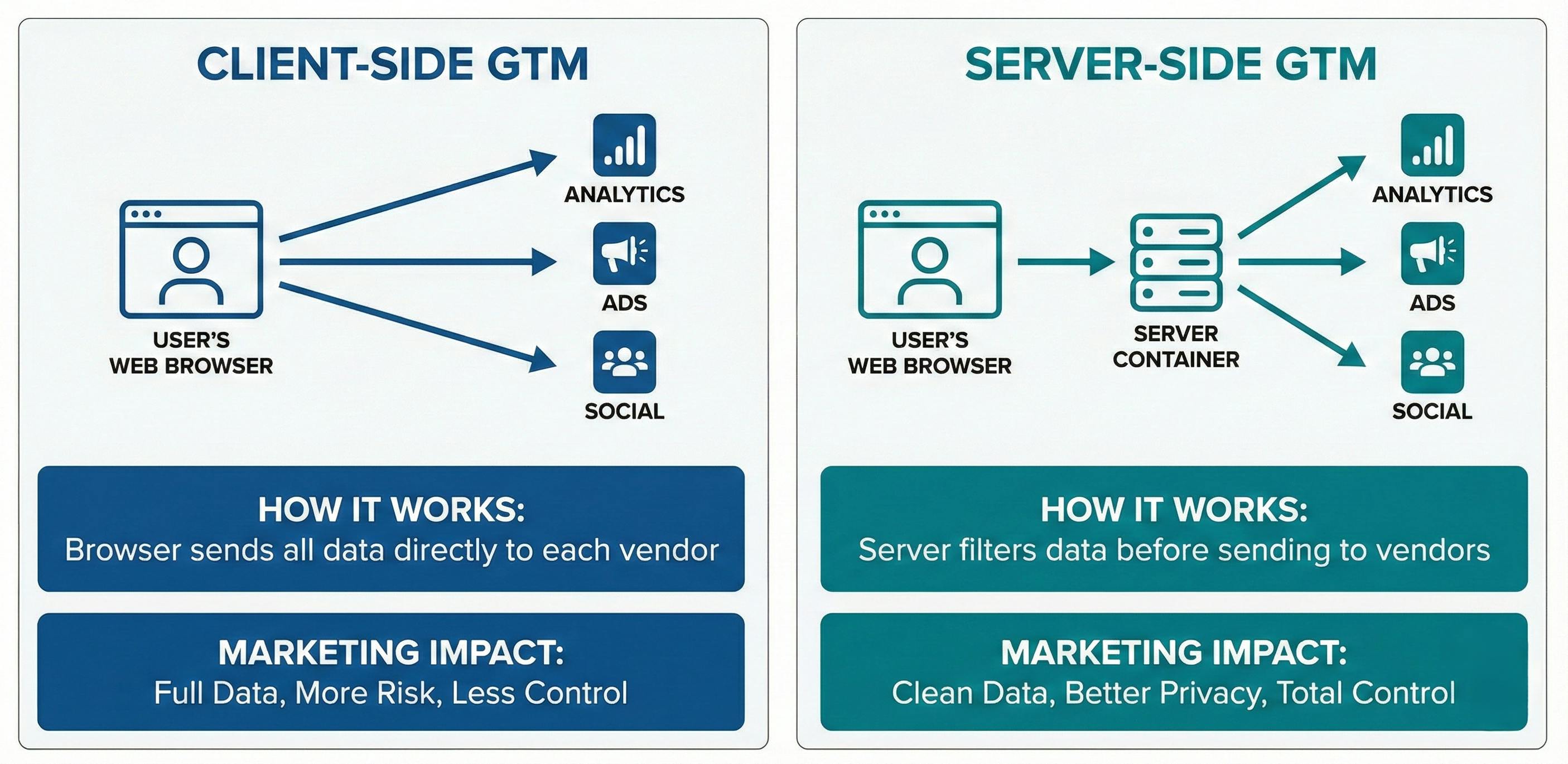
Client-Side GTM vs. Server-Side GTM
What happens if a user declines cookies?
In the old world, a 'Decline' click meant a data black hole. The scripts were blocked, and you lost 100% of the visibility. You didn't even know a visitor was there.
With Server-Side tracking, you can respect the user's choice while saving your business data. If a user declines, the server ensures no personal cookies are set, respecting their privacy completely, but it can still send an anonymous 'ping'. You won't know who they are, but you will still know that a visit or conversion happened. This is a win-win situation as it keeps your volume numbers accurate without violating privacy laws.
Additional benefit
One additional benefit you gain by opting to go server-side is that you can now remove all those heavy tracking scripts from your website.
Instead of your customer’s phone (or even any other device) loading heavy code from five different advertising platforms before they can click "Buy," it only needs to load one lightweight stream to your server.
This will ultimately increase your site’s speed. In e-commerce particularly, speed is revenue. Research consistently shows that even a 0.1-second improvement in load time can lift sales by 1%. Speed is non-negotiable and drastically impacts your conversion rates, so why not take some additional steps to ensure optimal speed.
Conclusion
Privacy restrictions are only going to get stricter. The best time to implement sGTM was 2024. The next best time is now.
In an age when customer lifetime value is seen as one of the most important statistics, when acquisition costs are constantly on the rise, and every conversion matters, you need to own every single bit of your data.
There is no room for guessing, and basing your marketing and business decisions on data filled with gaps, portraying a completely incorrect image, is an expensive game to play.