




The End of the Navigation Menu: Re-engineering for the Gen Z Customer
Gen Z has replaced traditional search with TikTok and AI. Learn how to re-architect your DTC website to capture high intent social traffic and stop massive revenue leaks.
As much as 55% of Gen Z have made a purchase based on scrolling.
And we don’t mean scrolling through your endless list of products. Their main source of information, credibility, and trust has shifted from the original sources to content creators, or influencers.
Imagine a quite simple scenario: a customer is doomscrolling TikTok or Instagram, and one of the creators they follow has just bought a new pair of shoes. They’re so comfortable, amazing for running long distances. They got to have them too. The link is in the comments or in the description. They click it and buy it. There was no research involved in the process, no comparison to other similar products, and no reading reviews on the product website. In other words, what just happened was their product research.

Image 1: Instagram Influencer Marketing, Source: Promo.com
The traditional website - a static, hierarchical, and keyword-dependent infrastructure - was built for the era of Google Search dominance. Today, this very website and the way in which it functions have become the main source of revenue leakage. And the main reason behind this is the shift that is happening in consumer behaviour.
While it is driven primarily by Generation Z, it is also being rapidly adopted by Millennials, which is why these changes cannot be treated as a fluke or a trend, and why you can no longer rely on your static site architecture in a now-conversational (and soon realistically agentic) market.
New Search Engines
Social Media
The main entry point of the e-commerce funnel has undergone a structural transformation.
For over two decades, Google Search served the entire internet by directing users based on explicit intent captured through keywords. The problem is that this took time, and it also required the customer to know exactly what they are searching for, so that they know how to search for it.
It included too much action and thinking on their own part, which made it all the more easy for customers to switch to what is more natural to how humans think, instead of how machines think.
Platform Metric | Gen Z (18-24) | Millennials (25-44) | Boomers (60+) |
Primary Search Preference: Social Media | 41% - 46% | 35% | <10% |
Primary Search Preference: Google | 32% | 50% - 78% | 94% |
Trust in Influencer Recommendations | 73% | 61% | <5% |
Daily Active Time on Social Platforms | 4h 0m+ | 2h 20m | <1h 0m |
Table 1: Generational Differences in Online Shopping Behaviour
Today, approximately 40% of Generation Z now utilise TikTok and Instagram as their primary search engines. They are no longer choosing the “ancient” method of opening a dozen Google search results, reading reviews from different sources, and comparing products.
Among Gen Z, 46% prefer social media for discovery over traditional engines, which is an impressive number.
This behaviour is even more pronounced in specific categories. For example, 67% of Gen Z prefer Instagram and 62% prefer TikTok when searching for local businesses, which relegates Google to a third-place position at 61% (Marketing Dive).
Generative AI
Many will argue that Google is not losing on relevance when it comes to product research and discovery. Even though it is still highly relevant, it no longer reigns as the only one or even the main one. Recent data from the 2026 Adobe AI Traffic Report provides a roadmap for the future of digital discovery. Traffic to retail sites from generative AI tools like ChatGPT, Gemini, and Perplexity increased by 693% year over year during the 2025 holiday season.
Generative AI makes for an even more important referral source, with as much as 77% of GenZ using AI tools for shopping. If your Gen Z customer is not using social media for discovery, they are doing it by talking to generative AI tools, which also help them get further down the funnel, making them higher intent customers.
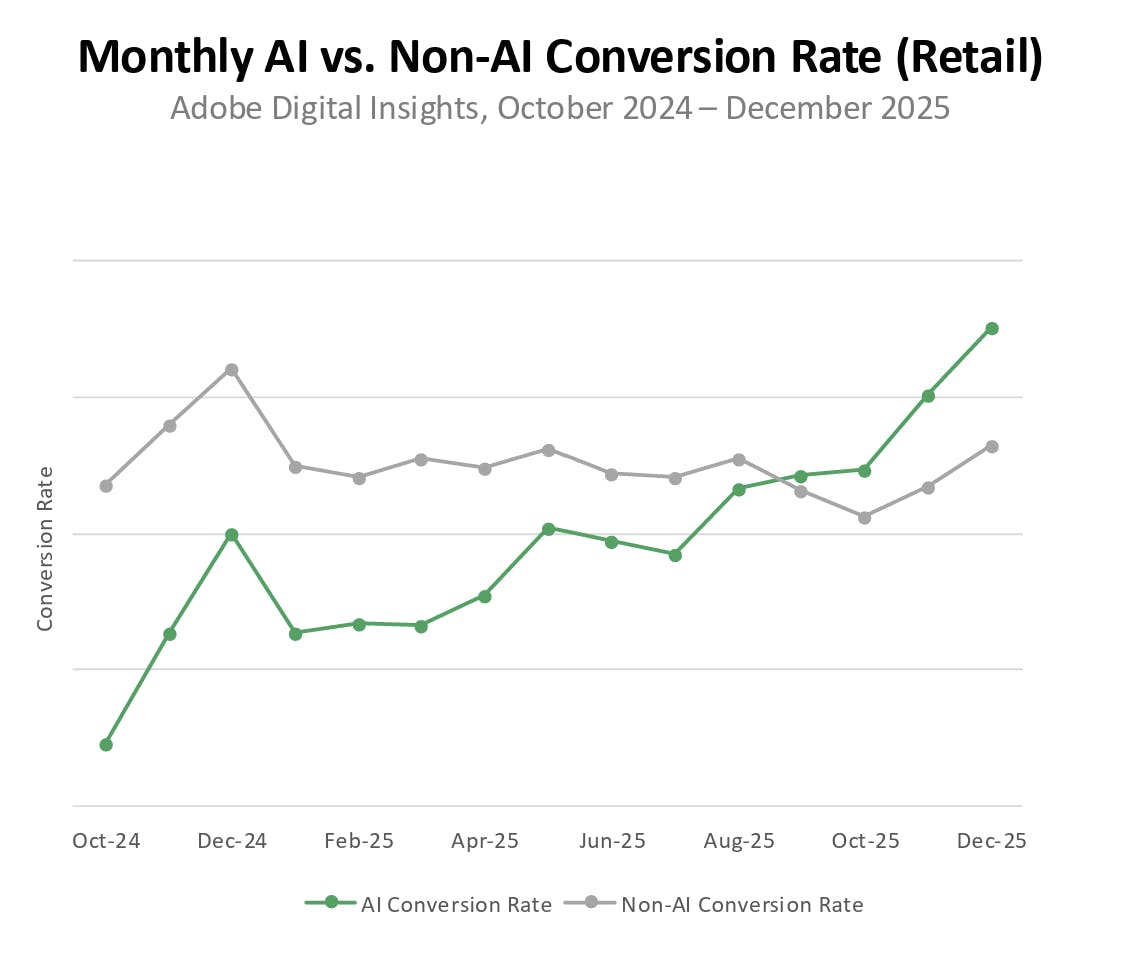
Image 2: AI vs. Non-AI Conversion Rates for Retail Websites, Source: Adobe AI Traffic Report
The diagram above proves the impact generative AI has on the intent of customers to actually purchase something, additionally confirming that what the new generations prefer is conversational and, what is more, visual discovery, which comes more naturally, mimicking human in-store interactions, while also being more intuitive and quicker.
This is not just "more" traffic. This is significantly higher-quality traffic. From a conversion perspective, shoppers arriving from AI platforms are far more valuable than those from traditional search:
- Visitors referred by AI show a 27% lower bounce rate than non-AI traffic on retail sites.
- These visits are 38% longer and involve viewing 10% more pages per visit.
- Engagement translated directly into higher conversion during the 2025 holiday season, with AI referrals converting 31% more than other traffic sources.
- Revenue per visit from AI referrals increased by 254%.
- Shoppers arriving from AI assistants are 33% less likely to leave a site immediately.
- These metrics prove that conversational interfaces help consumers be more informed and confident in their purchases.
If your website still relies on the old kind of infrastructure based on keywords, it is already lagging, and losing quite a bit of revenue.
Entry Point Friction and High Bounce Rates
And, while the way research is conducted has changed in its core, most e-commerce sites still require the user to restart their journey by navigating through generic menus or using a broken internal search bar. This creates a massive disconnect between the high-energy "scroll" and the low-energy "static site." CMOs are currently seeing a phenomenon called "traffic shock", resulting in large bounce rates of high-intent shoppers.
High-velocity social traffic hits a static website and immediately bounces at rates ranging from 60% to 90%.
If you take into account the kind of experience that leads the modern customer to the website where they can finish their shopping journey, the percentages become quite clear and understandable, as most DTC websites today still do not mirror the demands set by social and conversational sources that lead the modern customer to the very website.
Mobile Devices Influence
Mobile devices drive approximately 83% of all e-commerce traffic in 2025, yet they convert at a rate significantly lower than desktops.
Desktop conversion rates average around 3.9% while mobile conversion rates often hover near 1.8% to 2.5%. This is an architectural failure rather than a hardware limitation.
Traditional sites force users into a "desktop-era" behaviour involving multiple tabs. The mobile user is in a "flow mode" and expects a continuation of their social scrolling experience. If your mobile experience expects them to continue their shopping journey by later coming back to visit your website via desktop, they will simply not come back.
Technical friction further exacerbates this crisis.
Every single second of load time results in a 7% to 8% loss in conversions. For a brand generating £10 million in annual revenue, a three-second delay on a mobile landing page can equate to over £2 million in lost sales.
The End of the Navigation Menu
All these changes clearly signify that the traditional website infrastructure and logic have to change.
Your website was designed for "Researchers." This generation is represented by Millennials who type keywords into Google. They are comfortable (or more comfortable) browsing through category trees to find what they need. A major reason behind this is the fact that this is the generation that has grown up with this approach and used it for a long period of time.
Generation Z, on the other hand, is a generation of "Discoverers." They find products through TikTok, YouTube Shorts, and AI chat. They have conversations instead of typing keywords.
When a Discoverer lands on your site and sees a complex hamburger menu, they often leave. Users form an opinion about your website in about 50 milliseconds. Roughly 88% of visitors will not come back after a bad experience. Traditional navigation menus are a 2016 solution to a 2016 problem. They do not work for the modern user who expects instant satisfaction.
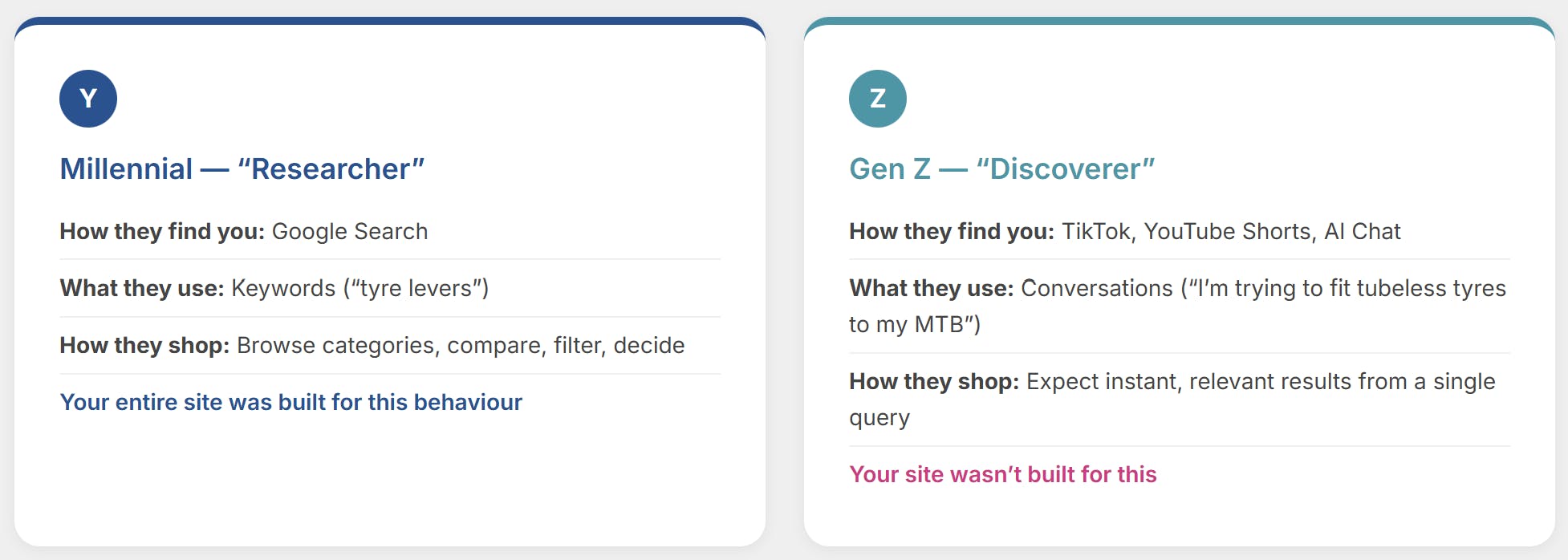
Image 3: Researcher vs Discoverer
Every click in your navigation tree acts as a leak in your conversion funnel. Only 16% of landing pages currently remove their navigation menu. Yet eliminating these secondary links can actually double your conversion rates.
The modern shopper has an average attention span of 8 seconds for discovery. Your three-level category menu burns through that time before a customer even sees a product. This forces them back into a research mode they are trying to avoid.
From GenZ to Millennials
A critical strategic error among many DTC brands is the assumption that social search is a "kid trend." Data from 2025 confirms a massive spillover effect where Millennials are rapidly adopting Gen Z behaviours. While GenZ is nowhere near the numbers to be ignored as online shoppers, taking up approximately 40% of consumers worldwide and 96% making an online purchase at least once a month, Millennials are still the most economically powerful online shopping demographic.
As of early 2025, 35% of Millennials prefer social media for discovery over traditional engines. Millennials and Gen Z together now account for over 60% of all DTC purchases.
Conclusion
The era of the passive and keyword-driven website is over.
The competitive moat of the future is architectural agility. Brands that deployed their own AI agents saw a 59% higher growth rate during peak seasons compared to those that did not.
Your website is no longer a storefront. It is an endpoint in a conversational customer journey, which is why you must move from a passive catalogue to an active sales engine. This starts by replacing keywords with conversations. You should build a multimodal search that accepts text, voice, and images. Users should be able to upload a screenshot from Instagram and match it to their catalogue immediately.
This technology allows your website to act like a shop assistant on a phone.
Before you invest in new technology, you must ask three questions about your current storefront. First, can your site be fully navigated with one thumb on a 6.8-inch screen? Second, can a customer find any product without opening a menu? Third, can an AI assistant understand your product catalogue? If the answer to any of these is no, your site is leaking revenue to the conversion gap.
Join the conversation
The year announced as the year of agentic commerce no longer seems like just simple predictions. We have already seen major news affecting retailers, and it is only February.
What does agentic commerce mean for your website? We're ready to cover this shift next Wednesday, so feel free to join us!
Register here: Wednesday, Feb 25th, 11.00 am (GMT)
Frequently Asked Questions
1. What is the "conversion gap" and why does it impact my revenue?
The conversion gap is the financial loss created when high-discovery social traffic hits a legacy website experience. Roughly $260 billion in orders are lost annually in the U.S. and EU due solely to friction in the checkout flow and poor design. This occurs because social traffic often lands on static pages that require the customer to restart their journey through generic menus.
2. How does AI search traffic perform compared to traditional search engines?
Visitors arriving from AI platforms are significantly more valuable from a conversion perspective. These shoppers show a 27% lower bounce rate and stay 38% longer on retail sites. During the 2025 holiday season, AI referrals converted 31% more effectively than traditional sources.
3. Why is the traditional navigation menu becoming obsolete?
Removing navigation links on landing pages can double your conversion rates. Multi-click navigation burns through the 8-second attention span of the modern Gen Z discoverer. Replacing menus with a conversational "Ask Anything" search bar allows customers to find products without clicking through a complex tree.
4. Can AI assistants really help reduce high return rates?
Businesses using AI-driven personalisation see 25% higher customer satisfaction. Shoppers who use AI for a purchase are 68% less likely to return the product because they feel more confident in what they bought. AI agents help by answering complex questions and providing styling advice before the customer hits the buy button.