




Visual and Voice Search for E-Commerce in 2026
Image search and voice shopping are reshaping e-commerce UX. See how D2C brands use visual and voice search to lift conversion rates and reduce bounce.
During our last week’s Webinar, we audited some of the most popular retail websites in the UK, focused primarily on their search bar experience. We’ve been talking extensively about the importance of shifting your attention to the search bar, as it has become (one of) the focal points of the shopping journey, and have established the four levels of its development, or rather, the four stages of its evolution.
The evolution of e-commerce has been defined by a progressive reduction in friction between human desire and product acquisition. While for a customer visiting your website, a simple keyword-based search bar was essentially enough, that is no longer the case. Your customers have changed – both in terms of who is visiting, with younger generations taking over a large percentage of online shoppers, as well as in terms of how all your website visitors are behaving once they reach your website.
So, while we’ve already established the importance of expanding your offer to a “conversational” one, we have yet to focus on other aspects of this conversation: voice and visual search.
The Evolutionary Stages of a Search Bar
Level 4 search bar maturity encompasses visual search, voice search, and AI-driven multimodal interactions that allow for a fluid, natural exchange of intent. In the contemporary landscape of 2024 through 2026, these features have transitioned from innovative "add-ons" to essential components of a competitive user experience (UX) and a prerequisite for high-performance conversion.
And here lies the issue. Not only do many retailers today not recognise the importance of an AI-powered search bar (let alone its voice and visual search additions), but they have also not yet even acknowledged the importance of the search bar itself. In many cases, it lies hidden somewhere on the website, its potential unused. Well worthy of the title of a “silent killer of conversions.”
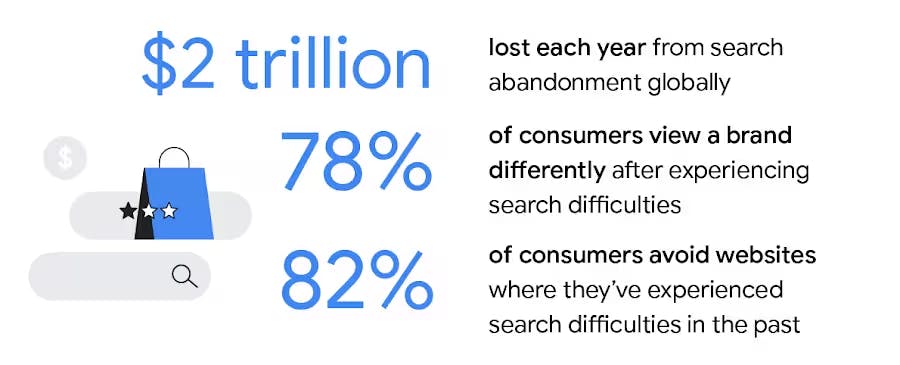
Image 1: Retail losses due to search abandonment, Source: Google Cloud Blog
The data on this shift is undeniable. As we look at how different demographics are interacting with technology, the "type-to-find" model is quickly becoming a relic for the generations with the most growing purchasing power:
Demographic Segment | Weekly Voice Assistant Adoption | Trust in AI Recommendations vs. Humans | Daily Use of AI Platforms for Shopping |
Generation Z | 77% (Smartphone-based) | 23% (Prefer AI) | 46% |
Millennials | 65% | 27% (Prefer AI) | 46% |
Generation X | 35% | 15% | 35% |
Baby Boomers | 26% | 10% | 18% |
Table 1: Voice and AI E-commerce Statistics per Generation
The 2025 "New Modes" report highlights that 33% of Gen Z shoppers and 26% of Millennials now prioritise AI platforms for product research over traditional search engines. This shift is indicative of an "always-on" shopping mindset, where commerce is embedded into cultural interactions, social media, and community spaces. Furthermore, 90% of Gen Z shoppers who use AI report that it significantly improves their shopping experience, a figure that has risen from 70% in 2024.
This is precisely what we’ve been highlighting: your customers are already using AI at one or all of the points of their shopping journeys, which means you cannot remain at the level they no longer want to use. They’ve seen what the technology can do for them and have adapted accordingly. It is up to you now to bring this kind of search to your own website, rather than leaving the entire journey to outside services (which will also charge you for it, as has been recently announced with OpenAI taking a 4% transaction fee).
The Current Stage of Visual and Voice in E-Commerce
While we were conducting our audit, we surprisingly found that none of the retailers offered either of the two to their customers. It is surprising in that you expect the ones that lead in the number of customers and purchases to trail the way and respond to the needs of their customers.
The global voice commerce market is projected to grow from $40.5 billion in 2023 to $147.9 billion by 2030, with voice shopping spend expected to hit $82 billion as early as 2025. This massive opportunity is currently being left on the table by the majority of UK retailers. Those who are leading the charge have largely moved these features into their mobile apps, creating a "maturity gap" between their web presence and their app experience.
To see what level 4 maturity actually looks like in practice, here is a list of the few retailers that have successfully bridged this gap:
- Marks & Spencer offers a "style finder" tool directly on their mobile website, allowing users to upload photos to find matching clothing in under 10 seconds.
- Argos has integrated a prominent microphone icon in their search bar to enable voice-activated product discovery and stock checks.
- IKEA uses their "Kreativ" app feature to combine visual search with augmented reality, letting users photograph their rooms to swap in new furniture.

Image 2: IKEA Kreativ, Source: IKEA
- Just Eat recently launched a "food concierge" voice assistant that handles "choice overload" by letting customers talk naturally to find their next meal.
- Wayfair uses an AI tool called "Muse" that lets shoppers describe a "vibe" or upload a room photo to generate a complete, shoppable look.
The Vocabulary Gap
The vocabulary gap is a psychological and linguistic barrier that occurs when a customer cannot precisely type in words (especially if you are still using keywords) that they are looking for. However, as we move to level 4, we realise that language itself is often a "low-bandwidth" input. Even with the best AI, describing a specific texture or an aesthetic "vibe" in words requires heavy cognitive effort. Visual search solves this by allowing the shopper to bypass the mental translation entirely. They don't need to know the words. They just need to show the image.
These are some of the sectors that can make the most of voice and visual search:
- Fashion and apparel: where a user may want "boho" but the catalogue says "bohemian." Visual search bridges this gap instantly, with 86% of visual searchers using the tool for clothing.
- Home decor and furniture: where subjective terms like "Scandinavian" or "industrial" overlap. visual search matches the aesthetic "vector" of a piece of furniture directly against your catalogue.
- Hardware and technical parts: where customers often don't know the names of components like a "hex-head flange bolt," a quick photo can identify the part and even point them to the correct aisle in-store.
Speed of Thought: Why Conversational Queries Convert Higher
One of the biggest differences between traditional search and level 4 search is the structure of the query. In text search, we are lazy. We type "black shoes." In voice search, we are expansive and context-heavy. A typical voice query is about 4.2 words long and often contains highly specific intent.
Research shows that voice search results load approximately 52% faster than standard text results. By processing these long-tail, natural sentences, your search engine moves from a simple "word matcher" to an "intent decoder," identifying exactly what the user needs before they've even finished their sentence.
Time-to-Product: the New KPI for Search Maturity
How should a brand measure the success of these level 4 features? While conversion is the ultimate goal, the true indicator of search maturity is time-to-product (TTP).
Studies indicate that visual search leads to checkout twice as fast as text-based search. In a world where a one-second delay in page load on mobile can reduce conversions by up to 20%, reducing the interaction time via voice or visuals is your biggest competitive advantage. Beyond conversion, you should be measuring:
- Zero-results reduction: how often visual search saves a query that would have traditionally returned no results.
- Return rate decrease: how much visual search and AR integration reduce "expectation mismatch" returns, often by 20–40%.
- Average order value (AOV) lift: the 20% increase typically seen when visual tools guide a discovery journey.
Conclusion
The site search maturity model isn't just a technical roadmap. It very clearly reflects the modern customer's desire for zero friction during their shopping journeys. If your search bar is still just a box for keywords, you are effectively sending your customers elsewhere, as different research shows people no longer have the patience to unlock the perfect combination of keywords in order to find what they want.
Moving to level 4 – the multimodal, conversational search – is no longer a luxury for early adopters. It is the new baseline for 2026. And the fact that even some of the largest retailers are still not responding to the obvious expectations of their customers leaves plenty of room for your own online stores to do it and take over your competition.
By removing the linguistic burden and meeting your shoppers at the "speed of thought," you transform your search bar from a hidden utility into your most powerful conversion tool.
Join the conversation
If you want to dive deeper into how to transition your brand from basic keyword matching to the level of semantic and conversational search we’ve discussed today, join us for our next Masterclass. We’ll be sharing the exact framework for navigating this 90% shift in search technology.
Register here: Masterclass: From Keyword Matching to Semantic Search - The 90-Day Roadmap

Frequently Asked Questions
- Do shoppers actually use voice and visual search regularly? Usage is now a daily habit for the demographics with the most purchasing power. Weekly adoption of mobile voice assistants is 77% for Gen Z and 65% for Millennials. Visual search is seeing a similar surge, with over 60% of younger shoppers stating they prefer image-based discovery over text for complex categories like fashion or home decor.
- Will adding these features slow down my website performance? Technically, these tools require more server-side processing, but the end-user experience is actually faster. Research confirms that pages accessed via voice search load 52% faster than standard web pages because they are built on leaner frameworks. To prevent lag, we ensure our implementations prioritise sub-10ms API response times.
- How do I measure if a search bar upgrade is working? The most effective indicator is the reduction in search abandonment. Shoppers who use the search bar are 2-3x more likely to convert, so any friction here is a direct hit to your bottom line. Success is measured by how much you can lower your "zero-results" rate and how quickly a user can move from their initial input to a product page.
- How expensive is it to incorporate these features? The primary cost isn't the software, but the "data debt" in your catalogue. At Firney, we start by auditing your current website and providing you with a plan for improvement. You can contact us for a free audit here.
- How does conversational search impact digital accessibility? It is one of the most effective ways to align with the European Accessibility Act (EAA). Voice search provides a "hands-free" discovery route for users with mobility or visual impairments who find traditional navigation difficult. It moves your site from a text-only interface to an inclusive, multi-sensory environment.