




The Zara Paradox: Why Legacy Brands Can Ignore AI Search
Discover why enterprise brands cannot afford to mimic Zara's minimalist product pages in the AI era. Learn how to optimise your data architecture for AI search agents and win high-value conversational referrals today.
AI visibility is a notoriously difficult game to play. Because the rules of generative engines are constantly being rewritten, everyone in marketing is trying to figure out precisely what gets a brand recommended.
Talk of llms.txt files, schema markup, and the latest Google core updates dominate LinkedIn and Reddit. You see them almost every day. But the real challenge isn’t just getting cited by an AI agent. The real challenge is staying there.
Just when you think you’ve cracked the code and earned a recommendation inside an AI search overview, you can vanish overnight. According to an analysis of AI citations by Writesonic, the average AI citation survives for just 11 to 15 days. Even more brutal, 44% of cited pages appeared only once before disappearing entirely [1].
In other words, AI citations do not behave like traditional search rankings. They do not decay slowly over months. Instead, they rotate rapidly. Your efforts may often seem futile, or you may think you’re being unsuccessful - having it hard to prove the ROI on GEO. However, the situation is as follows: AI visibility is not a one-time optimisation project, and it requires a continuous, high-frequency effort.
The Old SERP Rules vs Modern LLM Rules
In traditional Search Engine Optimisation (SEO), we played a very predictable game. The bigger the brand, the more likely they were to sit comfortably at the top of the Search Engine Results Page (SERP). It was incredibly hard for mid-market and challenger brands to break through that domain-authority noise, let alone someone new. Giant companies with endless backlink profiles held the top three spots like a fortress. Not to mention the sponsored ads at the top. You couldn't compete with brands who had much higher budgets.
Generative AI search completely upends this.
AI search engines do not just copy the top-ranking Google links to write their summaries. In fact, a 2026 study by Ahrefs and ConvertMate revealed that only 38% of citations in Google’s AI Overviews actually come from the traditional top 10 organic results [3]. The rest of the citations are split almost evenly between pages ranking in the top 10 positions and those within the first 100. Even the pages that sit entirely outside the top 100 organic results are getting a respectable percentage.
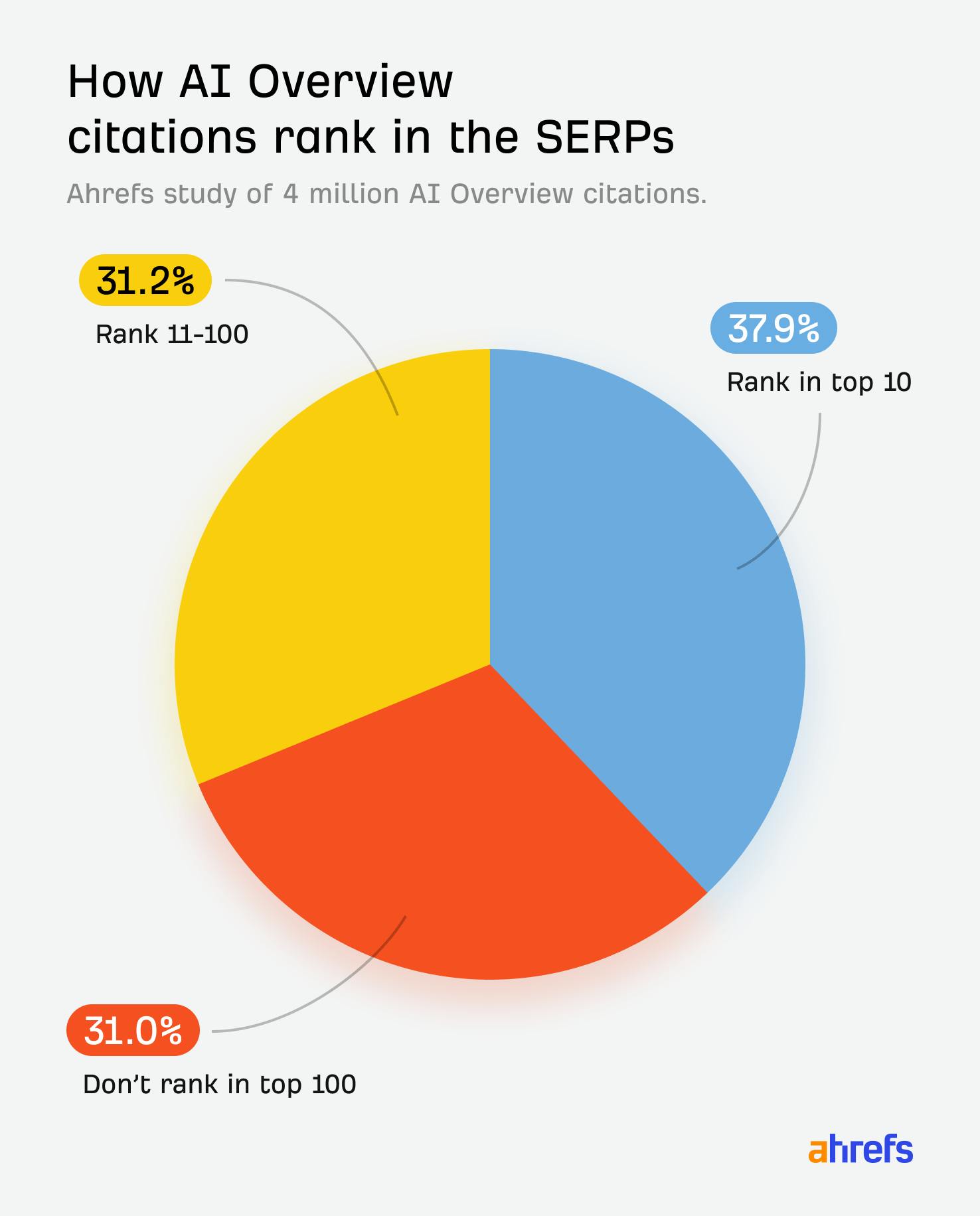
Image 1: AI Overviews Citations Rank in the SERPs, Source: Ahrefs
This means the playing field has levelled. Just a year ago, this data was completely different, with as much as 76% of top 10 SERP links appearing in AI Overviews [2]. If you provide clean, structured, and highly specific data, an AI engine will bypass the multi-billion-pound giant and cite your brand instead.
However difficult, it’s worth playing the game.
It is also worth noting that the fact that brands sitting at the top are recommended likely has nothing to do with the position itself. It is wrong to claim big brands are not visible. The top SERP links already (in most cases) have what AI looks for: they're the familiar brand present in third-party sources, the brand users mention, discuss about, and review. This is a major signal for AI models to choose this precise brand in their recommendations.
Why Legacy Giants Can Play by Different Rules
If you run a conversational search for fashion recommendations, you will quickly notice that Zara, for example, rarely appears in highly specific AI queries.
Take a look at one of their Product Detail Pages (PDPs). They are visually stunning but text-light. They favour editorial descriptions made exclusively for human eyes. While informative, they lack the depth AI needs to avoid hallucinations and to provide the ideal match for the user inquiry.
If a user makes a simple prompt such as: “find me green summer dresses on sale”, Zara is safe. They have a strong legacy and a brand known and talked about across the web.
However, if a user asks ChatGPT or Perplexity to find a machine-washable blazer with specific internal passport pockets for travel under £150, the AI cannot confidently recommend Zara. It lacks the structured product data to verify if Zara’s blazer fits those exact technical parameters. Because AI engines are designed to prioritise trust and avoid hallucinations, they will skip the guess and recommend a brand with explicit product specs instead.
Should Zara work on their PDPs to optimise them for generative engines? Yes. Will they do it eventually? Probably also yes. Can they survive without it? Another yes.
Zara's bottom line is completely fine. They can survive this gap for two reasons.
1. Massive Direct Traffic
Zara has earned the ultimate luxury of direct brand loyalty. Millions of customers do not start their journey on a search engine. They type Zara.com directly into their browser or open their app.
2. Brand Gravity
Because Zara has been a global powerhouse for decades, its historical data is deeply embedded in the foundational training models of top Large Language Models (LLMs). The static weights of ChatGPT and Gemini already know Zara's style, brand voice, and legacy.
The Two Pillars of AI Visibility
For companies that do not have Zara's multi-billion-pound brand equity, attracting users i 2026 requires a dual-track strategy. True Generative Engine Optimisation (GEO) relies on two pillars.
- The first pillar is on-site data agility, which means organising the information on your own website.
- The second pillar is your off-site footprint, which involves building your brand's image across third-party websites.
Zara already has the off-site footprint handled. They are discussed constantly on Reddit, YouTube, fashion blogs, and social media. Their reviews are everywhere. And it is already well-known that reviews are highly critical for LLMs, especially Google's Gemini and Bing’s Copilot, which pull directly from third-party sentiment.
In fact, data shows that brands with no review profiles have a median AI citation rate of just 1%, while those with established third-party reviews jump above 50% [4].
You do not have to be a fashion brand to leverage this. This dynamic is playing out across travel, telecommunications, and food.
How This Works Across Other Industries
Let’s look at how the battle between brand gravity and data agility plays out for other industries.
1. Travel & Hospitality
Established platforms like Airbnb and Booking.com have built incredible global systems that excel at high-volume, transactional searches. They possess massive, invaluable brand gravity. However, even alongside these platforms, boutique operators can capture highly targeted segments. If a traveller asks for a quiet hotel in Mallorca with a dedicated workspace, fibre-optic internet (>100 Mbps), and a lap pool, a local boutique hotel can make itself highly discoverable. They achieve this by structuring their product pages with explicit, bot-readable schema tags detailing these exact, unique amenities.
2. Telecommunications
Global telecom providers like Vodafone focus on serving millions of customers with comprehensive, multi-layered service packages. Independent eSIM providers can operate alongside them by targeting highly specific search intents. If a remote worker asks for a travel eSIM for a 14-day trip to Italy that allows hotspot tethering and has at least 20GB of data, the smaller provider can instantly supply the answer. By presenting clean, flat JSON-LD data tables on their landing pages, they help the AI crawler read and verify their precise package terms in milliseconds.
3. Food & Beverage (D2C)
Large grocery networks do an incredible job of managing thousands of complex inventory lines. Direct-to-consumer food brands can stand out by focusing heavily on precise dietary data. When a health-conscious consumer asks an AI assistant to find organic, gluten-free snack packs under 150 calories that do not contain soy or peanuts, the brand can make itself incredibly easy to find. They do this by turning their nutritional facts and allergen tables into rich, crawlable structured text.
Conclusion
Relying on vibes and minimalist copy is a luxury reserved for the world’s biggest legacy giants. For everyone else, the path to market share is clear.
The future of the e-commerce product page is a beautifully designed database. You must give AI agents the absolute data confidence they need to display your links in search overviews today. And you still cannot forget about the actual humans visiting your website.
But getting them to your site is only the first step. Once a customer lands on your page, you cannot let them fall back into a generic, clunky search box. You must lock in the relationship by offering a superior on-site conversational search tool. This acts as a digital personal assistant, answering their complex questions in real time and guiding them smoothly from discovery to checkout.
That is how you turn fleeting AI citations into permanent, direct customer relationships. We will cover this topic in more detail next week, so make sure to subscribe to our newsletter to stay informed!
FAQ
Frequently Asked Questions
Resources
[1] Foundation Team. "New Writesonic data shows AI citations have 11 to 15 day shelf life." Foundation Marketing. 2026. https://foundationinc.co/lab/vol-298/
[2] Louise Linehan and Xibeijia Guan. "76% of AI Overview Citations Pull From the Top 10." Ahrefs Blog. 2025. https://ahrefs.com/blog/search-rankings-ai-citations/
[3] Louise Linehan and Xibeijia Guan. "Update: 38% of AI Overview Citations Pull From The Top 10." Ahrefs Blog. 2026. https://ahrefs.com/blog/ai-overview-citations-top-10/
[4] Matt G. Southern. "SEO Pulse: AIO Citations Diverge From Rankings, Bing Rewrites Rules." Search Engine Journal. 2026. https://www.searchenginejournal.com/seo-pulse-aio-citations-diverge-from-rankings-bing-rewrites-rules/568881/
[5] MagnaWiz Research. "Traffic vs. Ranking: How Search Engine Optimisation Changed When AI Started Answering First." MagnaWiz Digital Report. 2026. https://magnawiz.com/traffic-vs-ranking-how-search-engine-optimisation-changed-when-ai-started-answering-first/