




The Marketer’s Guide to Measuring AI Search and Referrals
AI search is changing e-commerce attribution. We show you how to track AI referrals to improve your e-commerce reporting and prove your marketing ROI.
The emergence of AI meant the emergence of new ways of finding information online. Traditional search engines like Google used to function solely by providing a list of links the user would click on. It was then also quite simple to track the metrics on those links: clicks, impressions, etc.
Today, with modern tools like ChatGPT, Claude, Perplexity, Gemini and others, search results have changed to their core, and along has the way and the complexity of tracking them.
Not only that, but a major part of search is still happening within the traditional search engines, but now with an exception: 48% of searches trigger AI-generated summaries [1].
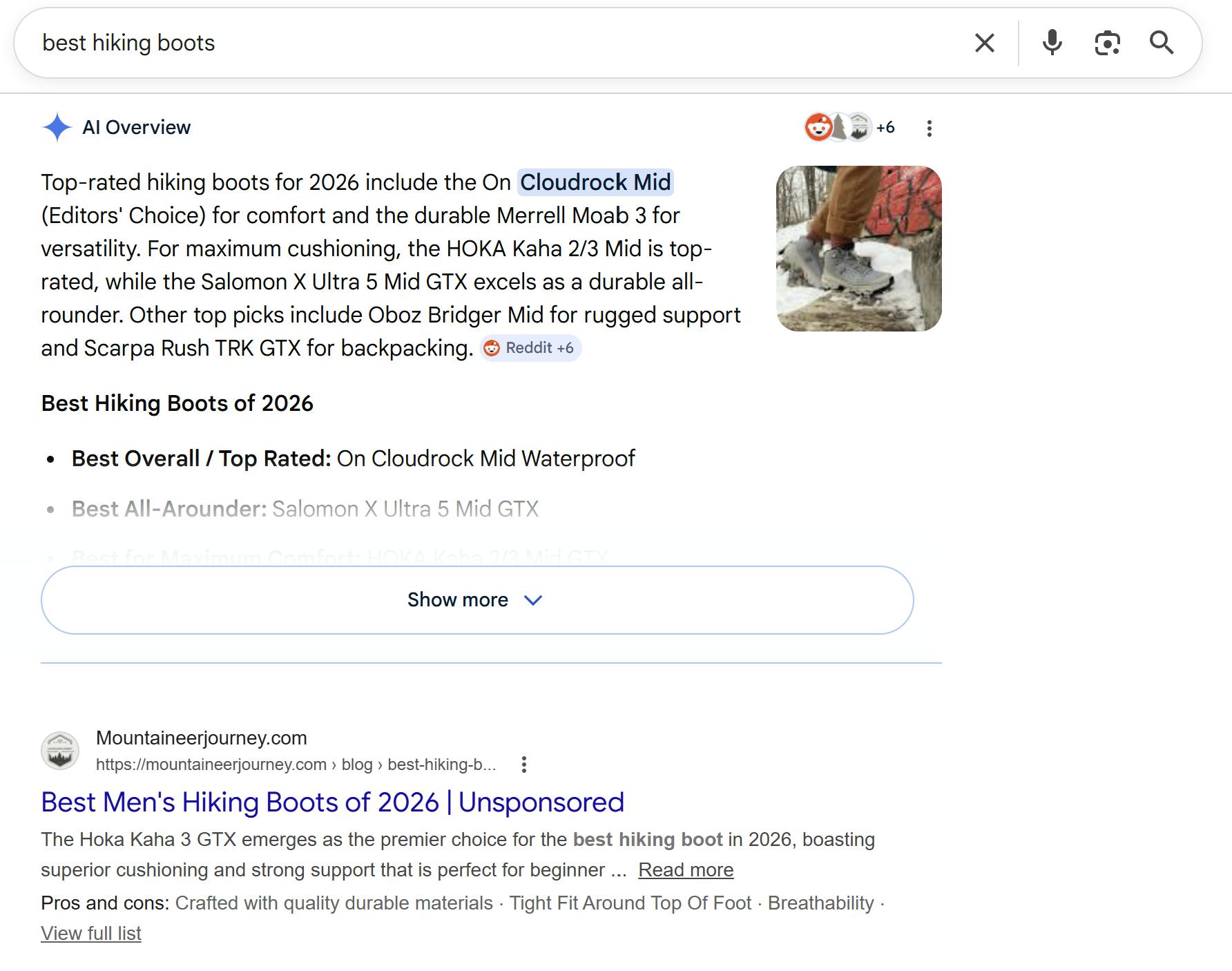
Image 1: AIO Example
These modern results are what we call AI referrals, which can be direct (when users click on sources directly from search results or when AI agents visit your website) or indirect (when users visit those suggested sources independently). It is the latter that is specifically difficult to track, and that may disrupt the metrics you keep track of. Standard analytics tools like Google Analytics 4 do not yet have built-in categories for this traffic. This means that extremely valuable high-intent buyers may go unnoticed, labelled as direct traffic or general referrals.
While we have already covered how to increase your chances of appearing in all the different AI-generated answers, we are now going to show you how to measure your success with those optimisation strategies to be able to prove their importance to the board, as well as the success of your marketing campaigns.
Source of AI Traffic
AI website traffic has two different sources, or two different kinds of users. One comes from human users who visit your website directly (or indirectly later on), and the other comes from AI agents who visit your website on behalf of a user, using your content to provide them with a summarised answer with real-time product pricing or inventory data.
Identifying AI-referred sources
The simplest AI-referred source to track is that of visitors who start their search via an LLM, get an answer, and then click a link provided by the LLM.
A human user clicking on a link provided by an LLM is the most visible kind of AI traffic.
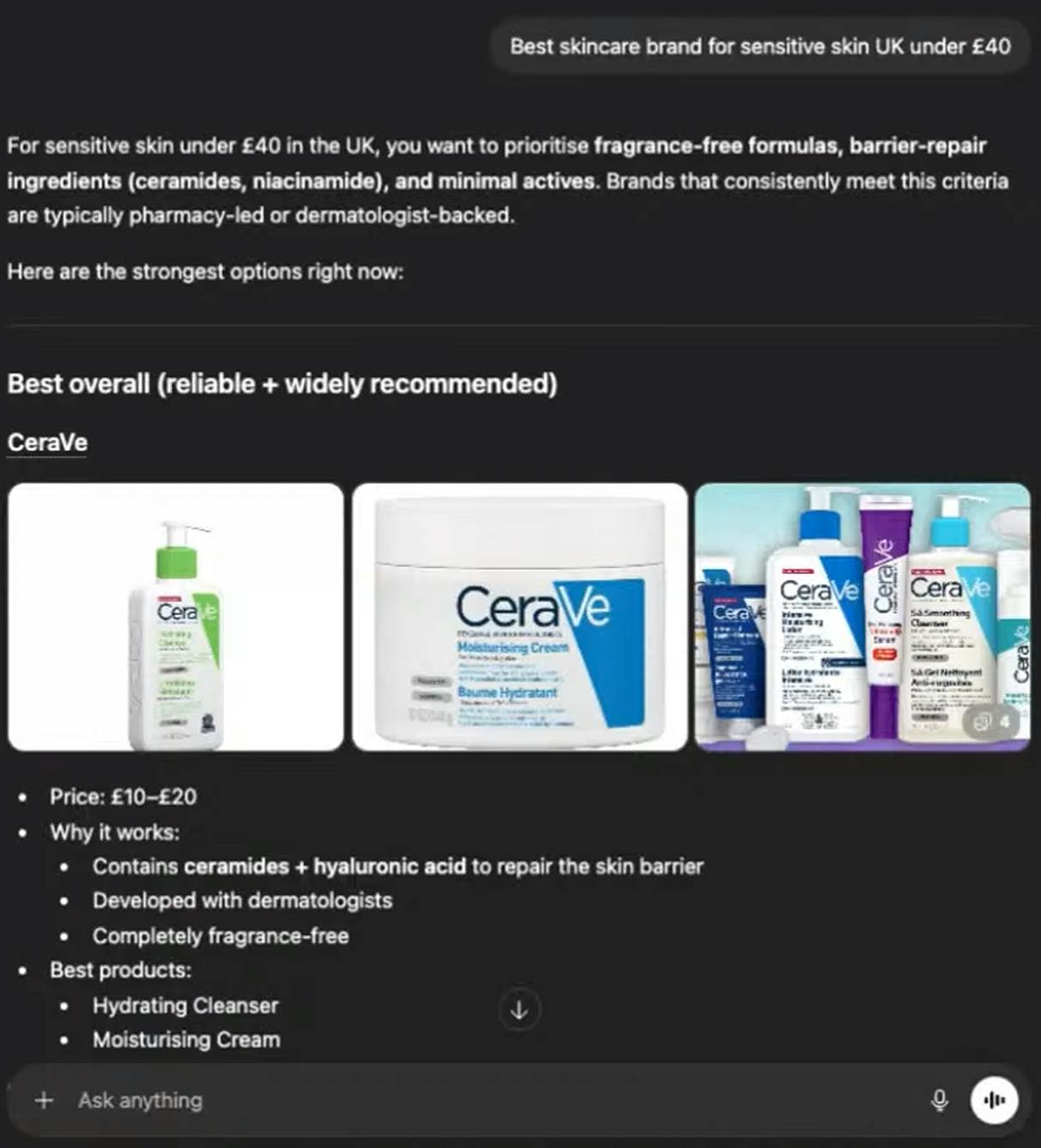
Image 2: AI Referral Example
The following table lists the exact domains and referrer strings that appear in analytics reports.
AI Platform | Known Referrer Domains | Observed Source / Medium in GA4 |
ChatGPT | chatgpt.com, chat.openai.com | chatgpt.com / referral |
Perplexity | perplexity.ai, www.perplexity.ai | perplexity.ai / referral |
Claude | claude.ai, anthropic.com | claude.ai / referral |
Gemini | gemini.google.com | gemini.google.com / referral |
Copilot | copilot.microsoft.com, bing.com | copilot.microsoft.com / referral |
Many sessions from these sources are still categorised as general referrals or even unassigned traffic. This happens because Google Analytics 4 is highly customizable and often depends on the specific way a browser handles the request [2]. If the platform does not provide a medium, the traffic is difficult to analyse alongside other marketing channels.
Custom Channel Grouping for Artificial Intelligence
While tracking AI referrals used to require manual effort in setting up custom channel grouping in Google Analytics, as of May 2026 Google introduced Agentic Browsing in GA4. This means you can now easily track AI referrals to your website, including a detailed overview of precise AI sources (ChatGPT, Gemini, Perplexity, etc.)
Hidden AI Traffic
Now we get to the part of traffic that is more difficult to measure. In certain cases, the traffic that is actually AI or referred to as AI is categorised as Direct, and this happens in the following situations:
- Visitors who come from AI apps after clicking your brand link
- Visitors who open a separate tab and directly type in your brand after it was mentioned in the AI summary
Why Loss of Referral Data Happens
AI Apps
In the first case scenario, the loss of referral data happens primarily due to how mobile apps and privacy settings work.
Native mobile apps like the ChatGPT app or the Claude app often open external links in a system browser or a webview layer. This transition frequently strips the HTTP Referer header. The header is the piece of information that tells a website where a visitor came from. If the header is missing, the website has no choice but to record the visit as Direct.
While your AI-referred traffic, on which you may have spent time to make it work, is actually working, your analytics are painting a different picture.
Separate tabs
The second case is quite similar to the first one in its nature, the difference is that it happens manually.
A user makes an inquiry, gets a summarised answer or product suggestion, and then uses that information to open a separate tab and find your brand by typing it in directly now or at some later point in time.
Once again, your analytics will show the source as Direct, while, in the background, the user journey is more complex and the source is actually AI.
Tracking AI Traffic
Landing page analysis the key to finding hidden AI visitors
A massive 70.6% of AI referral traffic arrives on your site without any attribution data [4, 14]. It is essentially invisible. To find these people, you have to look at where they land.
Most human users typing your URL directly into a browser will land on your homepage [1, 5]. AI tools are different. They link to very specific answers. If you see a sudden rise in Direct traffic to a deep blog post or a technical product guide, that is a clear signal of AI activity.
You should look for sessions in your Direct bucket that have unusually high engagement. AI visitors have already read a summary of your site before they click. This means they are often very focused. Research shows that AI-referred visits have a 27% lower bounce rate than traditional search . They also stay on the site for 38% longer [7, 14]. By filtering your Direct traffic for these long, highly engaged sessions on deep content pages, you can estimate the size of your hidden AI audience.
AI Impact in Google Search Console
Google Search Console provides a direct look at how often your site is cited by Google. In 2025, Google added a specific filter for AI Overviews and AI Mode in the Performance report . You can select these in the Search Type menu to see impressions and clicks specifically from AI summaries. You will often see a pattern known as the crocodile mouth. This is when your impressions go up because you are being cited more, but your clicks go down because the AI is answering the question on the search page.
You can also search for conversational query patterns. Users talk to AI in full sentences. You can use a filter in Search Console to show only queries that are ten words or longer [3, 4]. These long-tail questions are the exact prompts users are giving to Gemini and ChatGPT. If you see your impressions growing for these complex questions, your content is becoming a primary source for the AI's reasoning engine. This is a powerful signal of brand authority, even if the click volume is lower than traditional search.
What do server logs tell you about your AI future?
Server logs record every time an AI bot visits your site to learn from your content. You should monitor your logs for user agents like GPTBot or PerplexityBot. This is a leading indicator of success. If an AI bot crawls your product pages heavily this week, you will likely see a rise in AI referrals next month once the model updates its knowledge.
You can measure the return on this bot activity using the crawl-to-refer ratio [10]. This compares how many pages a bot crawls against how many human visitors it eventually sends back. For example, PerplexityBot often has a healthy ratio of 111:1. This means it is a search-focused bot that provides real traffic. Anthropic’s ClaudeBot has been seen with a ratio of 23,951:1 [10]. This bot is mostly training its model and sends very few visitors. Monitoring these numbers helps you decide which bots to welcome and which to limit if they are slowing down your server.
Using llms.txt file to help AI agents find your products
The llms.txt file is a new standard for the AI era. It is a simple text file you place in your website's root directory. It works like a tour guide for AI agents. It points them toward your most important structured data, such as your product feed or your FAQ section. Providing this file ensures the AI does not have to guess about your pricing or inventory. It is one of the first and most important steps to include in your AEO/GEO strategy.
AI models prefer to read clean data in JSON format rather than messy HTML code. If you link to a structured product feed in your llms.txt file, the AI can parse your catalogue much faster. This reduces the risk of the AI "hallucinating" or providing wrong details to a potential buyer. You should update this file whenever you launch a new collection to keep the AI's information fresh.
AI traffic vs organic search conversion
While the volume of AI traffic is still small, the intent is exceptional. During the 2025 holiday season, AI referrals converted 31% better than non-AI traffic [16]. Visitors from AI tools also spend 68% more time on the site [17, 18]. This is because the AI has already done the heavy lifting of comparing options for the user. When the user finally clicks your link, they are already at the bottom of the sales funnel.
For B2B brands, the difference is even more stark. AI traffic sign-up conversion is 1.66% compared to just 0.15% for organic search [1, 14]. This is an 11x premium in quality. You should not be discouraged if your AI traffic looks small. These visitors are your most valuable leads because they have already been "pre-qualified" by the AI assistant.
Conclusion
Default analytics setups are failing to show the true value of AI search for your brand. You must move beyond simple click counts and start measuring your visibility in the AI discovery layer. Proactively configuring your GA4 and monitoring your server logs is the only way to prove the ROI of your optimisation efforts.
If you have not yet strated with your AI website optimisation process, we can help you make the first step- Apply for a Firney GEO Website Audit today. We will assess your technical foundation and show you exactly where your AI revenue is hiding.
FAQ
Frequently Asked Questions
Resources
[1] OmniBound. "AI Search Statistics 2026." 2026. https://www.omnibound.ai/blog/ai-search-statistics
[2] MO Agency. "How to Track AI Traffic and Referrals in Google Analytics 4." 2025. https://www.mo.agency/blog/how-to-track-ai-traffic-and-referrals-in-google-analytics-4
[3] Beyond Space. "How to find Long-Tail keyword using Google Search Console." 2025. https://www.beyondspace.studio/blog/how-to-find-long-tail-keyword-using-google-search-console
[4] Reddit. "How to see AI search queries in Google Search Console." 2026. https://www.reddit.com/r/DigitalMarketing/comments/1rjw1em/how_to_see_ai_search_queries_in_google_search/
[5] HiGoodie. "llms.txt for eCommerce." 2026. https://higoodie.com/blog/llms-txt-for-ecommerce/
[6] Ecommerce Today. "Implementing llms.txt in Shopify." 2026. https://ecommerce-today.com/implementing-llms-txt-in-shopify-best-practices-for-seo-and-ai-indexing/
[7] Single Grain. "How AI-Driven Traffic Affects Time-on-Page Benchmarks." 2026. https://www.singlegrain.com/blog-posts/analytics/how-ai-driven-traffic-affects-time-on-page-benchmarks/
[8] MO Agency. "How to Track AI Traffic and Referrals in Google Analytics 4." 2025. https://www.mo.agency/blog/how-to-track-ai-traffic-and-referrals-in-google-analytics-4
[9] The Digital Bloom. "Gen AI Website Traffic Share February 2026." 2026. https://thedigitalbloom.com/learn/gen-ai-website-traffic-share-february-2026/
[10] SEOmator. "Crawl-to-Refer Ratio: AI Crawlers and LLM Bots." 2026. https://seomator.com/blog/crawl-to-refer-ratio-ai-crawlers-llm-bots
[11] Help Littledata. "How to create a GA4 channel for AI traffic." 2025. https://help.littledata.io/google-analytics/behavior/ga4-channel-ai-traffic
[12] Digital Applied. "GSC now separates AI Overview and AI Mode traffic from web search." 2026. https://www.digitalapplied.com/blog/google-search-console-ai-mode-track-ai-overview-traffic
[13] Digital Applied. "Google AI Mode: 75M Users, Ads in 25% of AI Results." 2026. https://www.digitalapplied.com/blog/google-ai-mode-75m-users-ads-in-ai-results-2026
[14] OmniBound. "AI Search Statistics 2026." 2026. https://www.omnibound.ai/blog/ai-search-statistics
[15] Technology Checker. "Robots.txt AI Crawlers Blocking Report Q1 2026." 2026. https://technologychecker.io/blog/robots-txt-ai-crawlers-blocking-report
[16] Reddit. "AI in ecommerce statistics 2026." 2026. https://www.reddit.com/user/elogic_commerce/comments/1sq4j3b/ai_in_ecommerce_statistics_2026/
[17] Triple Whale. "AI in Ecommerce Stats." 2026. https://www.triplewhale.com/blog/ai-in-ecommerce-statistics
[18] Cubeo AI. "25 Statistics of AI in E-commerce in 2026." 2026. https://www.cubeo.ai/25-statistics-of-ai-in-e-commerce-in-2026/