




The Missing Shopping Assistant: Why D2C Websites Need to Understand Customer Intent
Discover how e-commerce is shifting from keyword search to understanding customer intent, with real-world examples of the modern shopping assistant.
For years, customers had to work to get to what they were looking for. Even more, they always had to know exactly what they were looking for and type in the exact same keywords that matched their intent with the product they wanted to find.
Today, shoppers expect sites to understand their exact intent, and they expect them to do so immediately.
Today's shoppers lack the “patience” that used to be required when visiting a site. We're not talking about website speed only, but about the website actually understanding them.
We’re now at the shopping assistant era.
Analysis Paralysis
In psychology, analysis paralysis is defined as an inability to choose an option amongst those presented. One of the main causes is being presented with too many choices.
E-commerce brands have spent ages growing, and that growing for them mostly meant growing the catalogue. The more options you have, the better the chances that your website visitor becomes your paying customer
The logic in that cannot be disputed, but the overwhelming number of options currently available on most online stores is not necessarily seen as a good thing.
There is nothing intrinsically bad about having choices. However, the issue appears when an individual has to sift through them. A supposedly menial task of, for example, buying new boots, turns into an annoying and time-consuming process that requires keyword matching, filtering, comparing, reading reviews, and visiting other websites to do the same.
If you are a D2C brand, all of this is potentially dangerous for you, as each of these steps may result in the consumer getting frustrated and leaving your site for good.
Problem-Based Intent and the Semantic Shift
Shoppers frequently arrive with a problem to solve, not necessarily aiming at one specific product. They may not always know the name of the product they need. So you may have a scenario where a customer might type "my bicycle tyre broke how do I find a replacement and fix it". Or, at least, that is something they would like to type.
A traditional search engine looks for products containing the words "bicycle", "tyre", "broke", and "fix". It often returns zero results or displays irrelevant repair manuals if you face it with a complex inquiry.
The 2026 Baymard Institute E-commerce Search UX audit shows that 56% of retail sites fail to support basic user search needs. Furthermore, 43% of sites fail completely on "use case" searches where the user describes a problem or scenario.[6,7]
4 Examples of D2C Websites That Understand Intent
Etsy
Etsy is a great example of understanding customer intent. Their search bar, while not conversational, goes beyond simply matching keywords with product titles and descriptions. This is particularly important for Etsy because of the sheer variety of products available on the platform and the fact that many of those products are unique, handmade or personalised.
This makes for a great solution considering their vast range of products, not typical of other e-commerce stores. A customer searching Etsy might not know the exact name of the product they want, and they may not even be looking for a specific product yet. They could be looking for "a funny gift for my sister who loves gardening", "something personalised for a new home", or "vintage decor for a cosy bedroom". These searches contain much more information about the customer's intent than a traditional product query, but they don't necessarily map neatly to a single product category.
Etsy's search experience is designed to interpret these types of queries and surface products that match the broader meaning behind them. Rather than requiring the customer to break their thought down into keywords and navigate through categories, the search experience can use the context of the query to present relevant products and, importantly, inspiration.
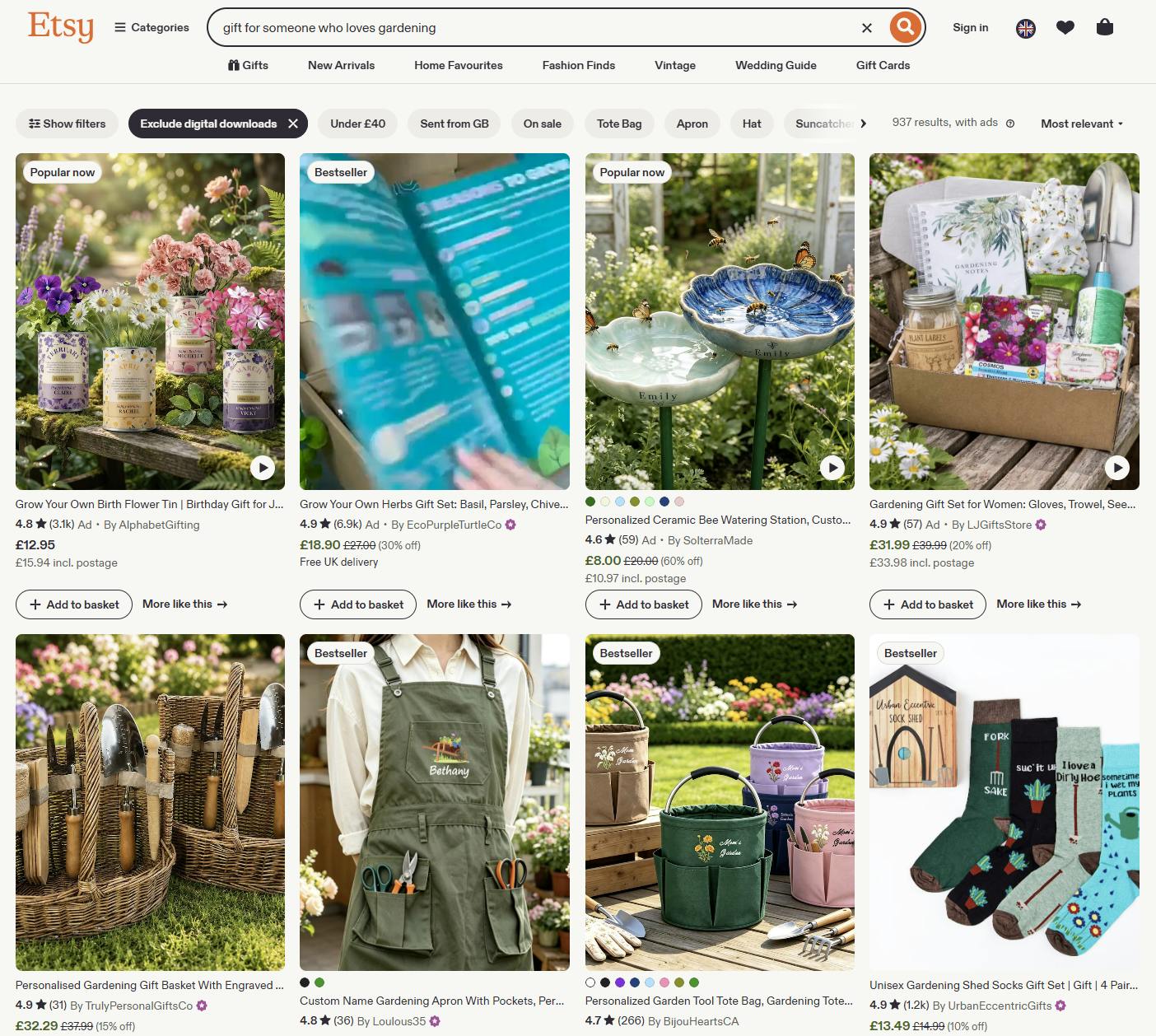
Image 1: Etsy search bar, Screenshot
IKEA
IKEA is an interesting example because customers rarely arrive knowing exactly which products they need. They might know that they want to make their small living room more functional, create a home office in a limited space, or make their bedroom feel warmer. The problem is that none of these are really product searches.
The customer is starting with an outcome. Usually, they would have to go one tiny step at a time, filtering through every single piece of furniture they need. This is important because a customer looking to "create a cosy bedroom" shouldn't necessarily have to start by searching for "bedside table", then "lamp", then "rug", then "duvet cover".
They need help understanding what products can collectively solve the problem they have. In the scenario they created, the website uses its catalogue to assist the user with their project by understanding the bigger picture.
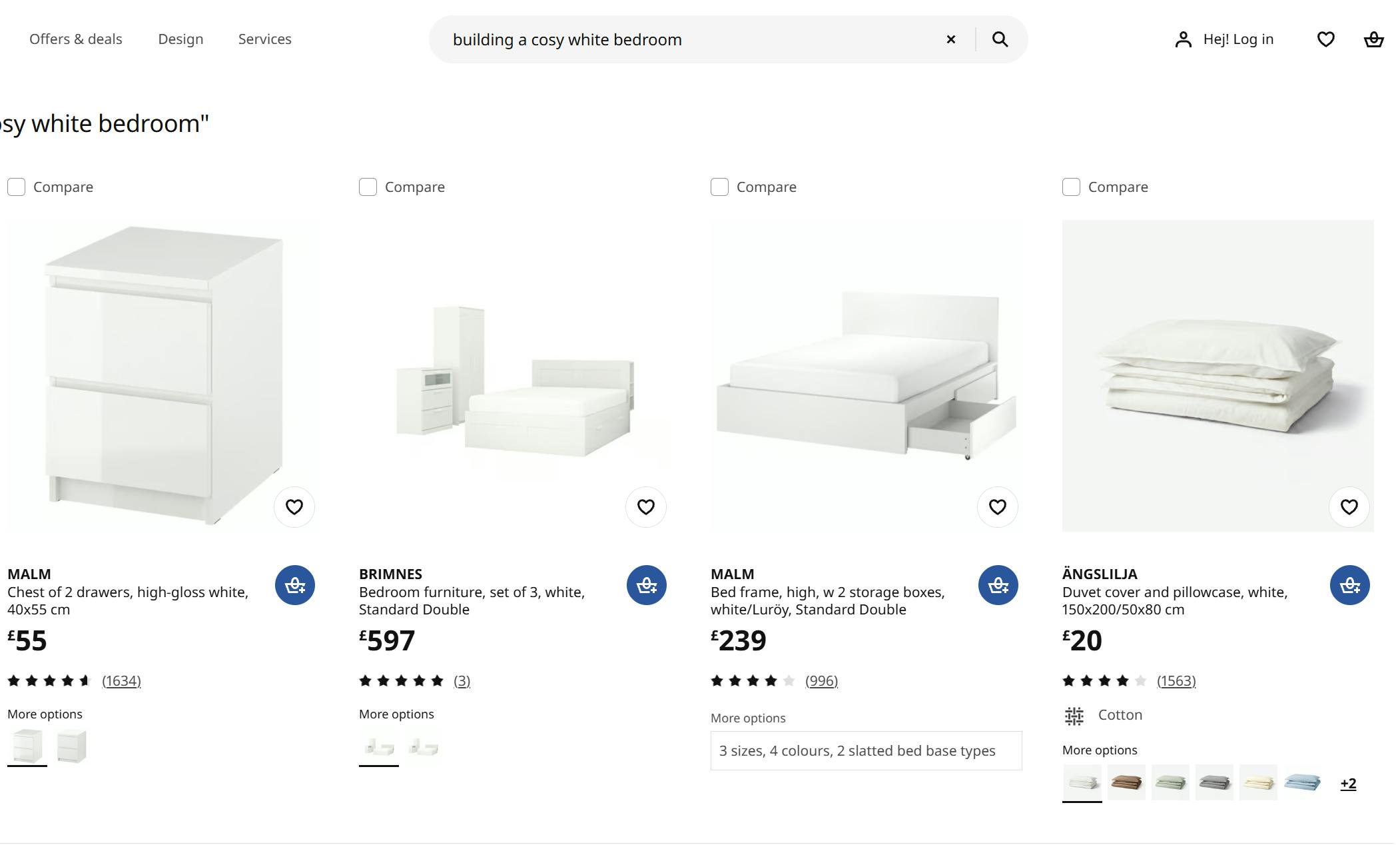
Image 2: IKEA search, Screenshot
Lowe’s
Home improvement may be one of the clearest examples of why ecommerce needs to understand intent at a deeper level. In 2025, Lowe’s introduced a shopping assistant [1] that not only helps their customers understand what they need, but it also helps them understand their customers and how they research.
A customer rarely thinks in product terminology when something goes wrong at home. They think "I need to fix a hole in my wall", and need help to do it. It’s a problem that needs a solution, not a list of keywords. What is more, the customer may have no idea what the product required to solve the problem is actually called.
This is where Lowe's AI shopping assistant, Mylow, is particularly interesting. Rather than requiring customers to begin with a product name, the assistant allows them to ask questions and describe what they are trying to accomplish. It can then help guide them towards products, projects and information that can solve the problem - just as an in-store employee would.
This is a much closer representation of human shopping behaviour.
Direct Ferries
Travel is a good example of how even when customers know exactly what they want, they may not know how to search for it.
Someone might know they want to travel from the UK to France, but not know which ports connect the two countries or which route makes the most sense. For Direct Ferries, this meant customers often had to figure out the underlying route structure before they could even start their search, which led to their support teams handling more than 7,000 FAQ-style enquiries, many of them related to finding the right ports for an intended journey.
Firney's AI-powered Booking Assistant was designed to remove this friction by interpreting natural-language queries such as "UK to France" and expanding them into relevant port and route combinations.
The important part here is that the customer doesn't need to know the system's terminology. They can describe the journey they have in mind, and the technology can translate that intent into the routes and products available.
This is what makes intent-based search different from simply making a search bar conversational. The goal is not to make customers better at searching. It is to make the website better at understanding what they mean.
Conclusion
Customers don't naturally organise their needs around e-commerce taxonomies. They think about problems, situations, preferences, occasions and outcomes.
Someone shopping for a gift might search for "something for a 10-year-old who loves dinosaurs". Someone looking for clothes might want "something nice for a summer wedding but not too formal". Someone buying a mattress might be looking for "something that doesn't make me wake up with back pain". Someone looking for a laptop might simply want "something that can handle Photoshop without costing a fortune".
These kinds of searches are much closer to how people naturally express intent.
The problem is that e-commerce has historically been designed around the assumption that the customer already knows what they are looking for.
This is partly a consequence of how product data is structured. Retailers have categories, attributes, SKUs and taxonomies, while customers have problems, preferences and expectations. The job of search has traditionally been to connect the two through keywords.
Online shopping removed much of the original interaction happening in a physical store between a customer and a salesperson, and replaced it with filters, categories and search boxes. It made everything closer and easier to get, but in a way also made it harder for the customer.
AI and semantic search give e-commerce a much better way of closing that gap. The goal is to make the website capable of understanding the customer in the same way a good salesperson would.
The shift from keyword matching to intent understanding represents a change in the role of e-commerce itself: from a catalogue that customers have to navigate, to an experience that can understand what they are trying to accomplish and help them get there.
That is the direction e-commerce is moving in.
FAQ
Frequently Asked Questions
Resources
[1] Customer Experience Dive. "What Lowe’s Has Learned From the Mylow AI Assistant." Customer Experience Dive. 2026.
[2] Etsy. "How to Search for Items and Shops on Etsy." Etsy Help. Accessed 2026.
[3] Etsy UK. "Gifts They'll Love." Etsy UK. Accessed 2026.
[4] IKEA UK. "Ideas." IKEA UK. Accessed 2026.
[5] IKEA UK. "Design and Planning Tools." IKEA UK. Accessed 2026.
[6] Baymard Institute. "E-Commerce Search UX." Baymard Institute. Accessed 2026.
[7] Baymard Institute. "Ecommerce Search Query Types: The 12 Query Types Users Rely On." Baymard Institute. Accessed 2026.
[8] Google Cloud. "New Research on Search Abandonment in Retail." Google Cloud Blog. 2023.