




AI in Travel: How AI Is Changing Travel Discovery and Booking
AI is changing how travellers research, compare and book. Discover why travel brands need AI visibility and on-site conversational AI agents to turn discovery into conversion.
As AI becomes more integral in our everyday lives, it is not surprising that more and more people use it to plan their travels.
Among UK respondents who had used AI for travel planning:
- 57% used it to find events/activities
- 59% used it to select accommodation
- 52% used it to find restaurants
- 51% used it to search for tickets
- 41% even booked hotels through AI
While trust still seems to be lagging behind actual usage, that isn’t stopping adoption of AI for travel planning, with travellers using AI before, during, and even after their travels.
External AI Discovery for Travel
Rather than opening 15 different tabs, today’s user will likely start their travel planning with ChatGPT, Gemini, Claude or some other LLM.
They might, for example, ask:
- "Where should I stay in Mallorca with two children?"
- "Which ferry should I take from X to Y?"
- "Find me a family-friendly hotel near the Paris train station under 200 euros..."
- "What are the best restaurants for vegetarians near..."
- "What's the cheapest way to get from A to B?"
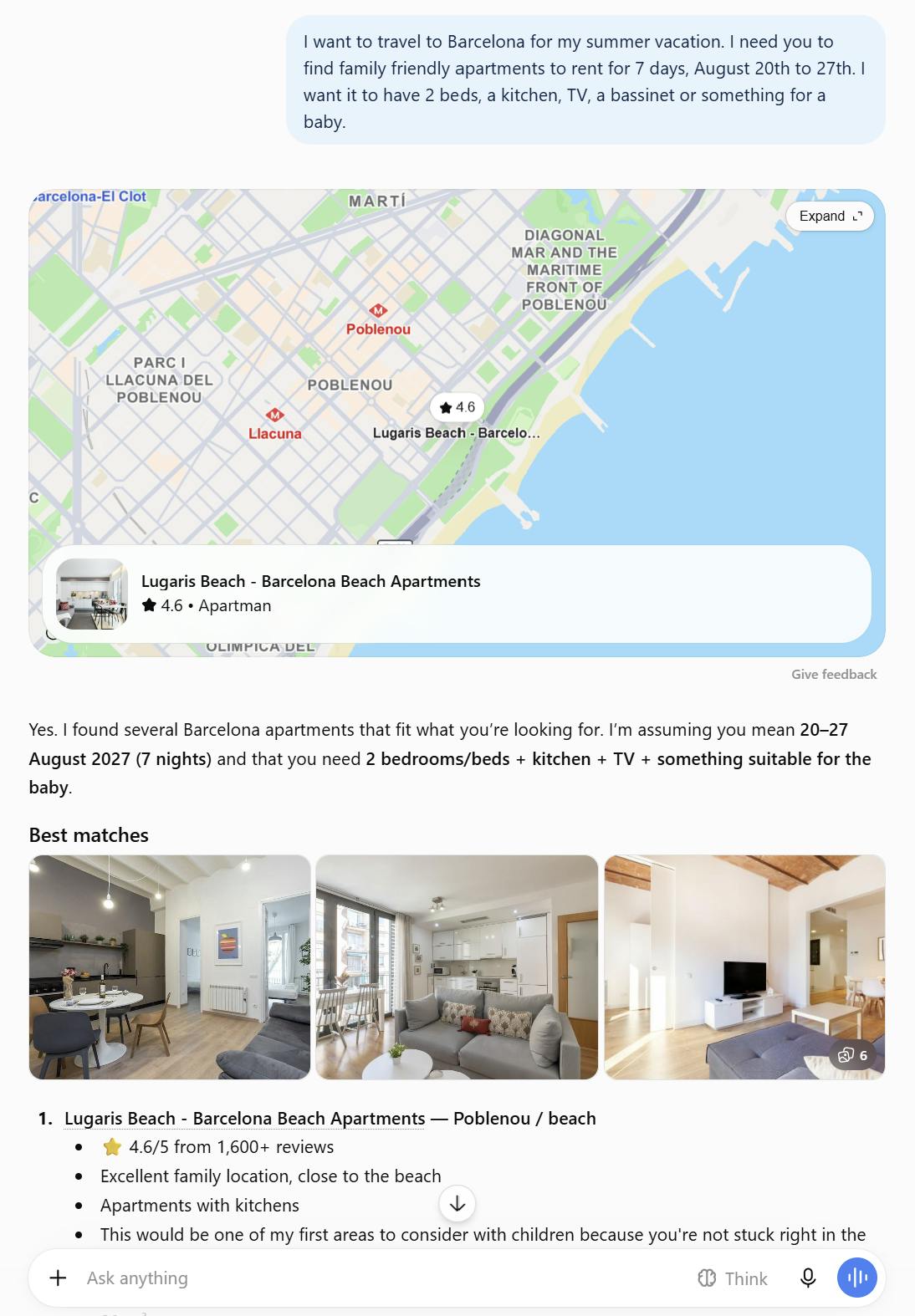
Image 1: ChatGPT Vacation Search Example, Screenshot
Why this matters for D2C companies? If AI crawlers cannot find this information on your website, they cannot recommend you. Your goal is to give AI enough reliable information to confidently answer the questions your customers are asking.
A 2026 study analysing 1.6 million sessions on a Mediterranean destination portal found that traffic arriving from AI assistants converted at 8.26%, compared with 3.88% for organic search - more than twice the rate [5]. Additionally, AI-referred visitors have engagement rates 21% higher than visitors from other sources, spending 70% longer on websites [6].
In the March 2026 Adobe Consumer Survey [6], respondents reported using AI for different tasks related to travelling:
- Research: 48%
- Inspiration and recommendation: 44%
- Budgeting: 30%
- Packing help: 21%
Make the information AI can recommend you for easy to find and understand. Things like: current opening hours, prices and pricing conditions, availability, location, amenities, cancellation policies, transport information, accessibility, family/pet policies, frequently asked questions, product/service differences, up-to-date destination information, and any other information your target user might inquire about.
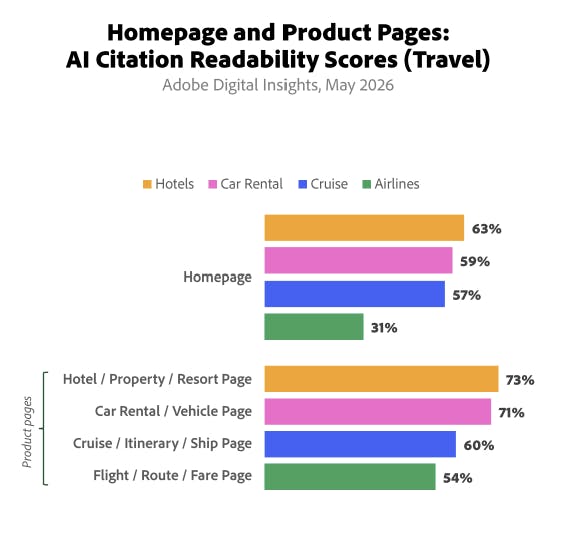
Image 2: Current AI Citation Readability, Travel sector, Source: Adobe 2026 [6]
Travel sectors that manage to communicate this information to AI crawlers are more likely to be a part of AI-driven discovery, recommendation, and comparison, and thus get directly in front of a high-intent audience.
Trust in AI
Trust in AI remains an important topic to discuss. Just like with any other AI application, users still struggle to trust it completely. In fact, when it comes to AI and travelling, only 23% of users trust it to plan their trips [1].
However, of those who have used it, as many as 91% are happy with the experience and 80% plan to use it again for the same purpose [1]. These numbers just prove that it is not about a poor experience, but about the lack of trust. And the lack of trust is not unjustified. AI is known to hallucinate and give its users information that does not exist. When it comes to actions that require the user to spend money, such as travel or any other form of buying, everyone is, naturally, more careful.
AI can hallucinate when planning travel, generating plausible but false information such as non-existent restaurants or incorrect attraction opening hours. A 2026 study of AI-generated travel itineraries found that hallucinations significantly reduced users' perceptions of accuracy and trust [2].
One of the main reasons AI hallucinates is the fact that it lacks proper and up-to-date information from the websites it crawls. If it cannot find an answer to the user’s question, it will likely make something up - or, even worse for your brand, avoid you.
With the growing number of people using AI on a daily and weekly basis, this should be a wake-up call for websites to provide all the necessary information so that AI can confidently recommend them.
Other Applications of AI in Travel
The use of AI by travellers is not limited to the different aspects of research before the travel. A great example is using AI for communication purposes once the destination is reached, navigating unfamiliar public transport systems in real time, for instant currency conversion and local cultural tips.
Current State of AI: Airbnb and Booking.com
Airbnb
While Airbnb doesn’t have its own conversational agent, it uses AI for other interesting purposes. Their custom AI agent now resolves over 40% of customer support issues [3], with drastically improved resolution times, using information from company policies and prior conversations and case adjudications.
For modern customers, personalisation is at the top of the list of their priorities, and Airbnb recognised this. This is why they have implemented an AI-driven (instead of a keyword-driven) personalisation for their website, with the algorithm building a personalised list of results for every specific user.
The algorithm uses all the available information to position the top-matching results, such as pricing, listing quality, guest experience, cancellation history, click-through rate, conversion rate, as well as the user’s own search patterns.
Booking.com
Booking.com has also recognised the changed behaviour and expectations of their target users and has thus launched a set of AI tools such as AI Trip Support, AI Voice Support, and AI Rental Helper [4].
AI Trip Support works on each listing as its own support, quickly answering any user questions based on the information provided by the listing, i.e., the property owner. For more complex questions, the tool will hand the conversation over to a human agent.
AI Voice support helps travellers with trip management, reducing resolution time. Travellers can ask any trip-related question in their own words, and the AI tools will assist in quick resolution.
On-Site Conversation
AI can get the user to your website, it might recommend your hotel, airline, ferry, attraction or travel service, but what happens next is completely up to you. While someone arriving from Google might still be browsing, someone arriving after asking AI: "What's the best family-friendly ferry option?" has already expressed intent.
Your website shouldn't and cannot simply give these visitors another generic navigation experience. What it should do is help them continue the conversation and just pick up where they left off.
What is more, Adobe’s research points to a major “hole” that can be filled by AI. The pages that have the highest AI readability scores are pages that are mostly informational: benefits, policies, support options, FAQs, loyalty pages, etc. However, when it comes to pages that are formed by user input, those that need to be personalised, or that depend on dynamic information such as availability and pricing, they exhibit lower AI readability.
This creates an opportunity for travel brands to move beyond AI visibility and towards AI-assisted conversion. In other words, the opportunity isn't simply to make travel websites more readable to AI, but to make them more actionable through AI. External AI can help travellers discover and evaluate options (which they excel at), but on-site AI agents can take that intent and turn it into action by accessing real-time availability, pricing and customer data to provide personalised recommendations and guide users through booking.
Case Study: Conversational AI in Travel
A solution we implemented for Direct Ferries is a great example of optimising website user experience with conversational AI. This technology removes the tiring manual process of researching either by using keywords (replaced with AI search) or filters (replaced with conversational AI).
The AI assistant Firney built for Direct Ferries handles any complex inquiry and responds to it in a natural and conversational manner. The old forms and filters are replaced with a conversation that is intuitive, can answer questions 24/7, uses the client’s own knowledge base (which gives them complete control over what information is shared) and is always up to date.
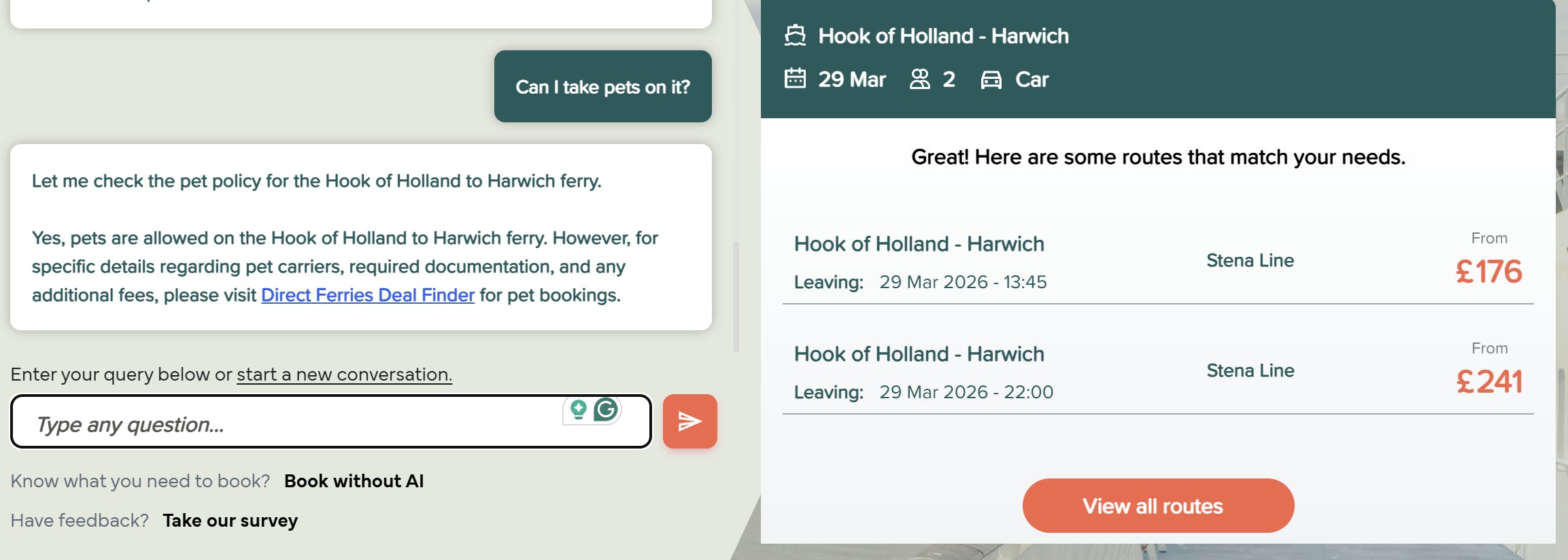
Image 3: Direct Ferries AI, Screenshot
While AI can refer the user to Direct Ferries, it is their own AI agent that continues the interaction, personalising the experience and ultimately guiding the user towards conversion.
Conclusion
The current state of AI in travel, even with the biggest players in the game, still has a lot of room for improvement. Different research continually proves that the way we search online has intrinsically changed - we can even say it’s been turned upside down. The user wants personalisation and a conversation. They want a personal travel agent that understands all their needs and requirements.
Your first step is to get recommended by AI to get the high-intent user to visit your website. Your second step is to get that user to convert with the help of your own custom conversational AI agent.
FAQ
Frequently Asked Questions
Resources
[1] Kaspersky. "Is AI Underrated as a Travel Agent? Kaspersky Survey Shows Only 23% of UK Travelers Use AI to Plan Their Trips, but More Than 91% Were Happy With the Results." Kaspersky. 2026. https://www.kaspersky.co.uk/about/press-releases/is-ai-underrated-as-a-travel-agent-kaspersky-survey-shows-only-23-of-uk-travelers-use-ai-to-plan-their-trips-but-more-than-91-were-happy-with-the-resultsuk
[2] Wiley Online Library. "Consumer Behaviour." Wiley. 2026. https://onlinelibrary.wiley.com/doi/10.1002/cb.70105
[3] AirROI. "Airbnb AI Platform Transformation: How AI Is Changing Airbnb for Hosts in 2026." AirROI. 2026. https://www.airroi.com/blog/airbnb-ai-platform-transformation-hosts-2026
[4] Booking.com. "Booking.com Debuts Agentic AI Innovations, Adding to Its Robust Suite of GenAI Tools for Customers." Booking.com. 2026. https://news.booking.com/bookingcom-debuts-agentic-ai-innovations-adding-to-its-robust-suite-of-genai-tools-for-customers/
[5] MDPI. "AI Assistants and Travel: Evidence From 1.6 Million Sessions on a Mediterranean Destination Portal." Tourism and Hospitality. 2026. https://www.mdpi.com/2673-5768/7/4/107
[6] Adobe. "AI Traffic Trends Report." Adobe. 2026. https://business.adobe.com/resources/sdk/q3-ai-traffic-trends-report.html