




Engineering Your D2C Store for Zero-Click Commerce
Rising PPC costs and shifting organic search dynamics are squeezing D2C margins. Learn how to optimise your store architecture for 2026 AI discovery.
In 2026, buyers are asking LLMs for product curation, and the "click" to your website is becoming an endangered species.
Open LinkedIn or Reddit and you’ll encounter a number of posts discussing whether SEO and the new optimisation strategies, i.e. GEO (Generative Engine Optimisation) and AEO (Answer Engine Optimisation), are all just your basic SEO or not.
Our stance is that it is not. While it is quite irrelevant how you call it, the fact of the matter is that there seems to be a new sheriff in town, and it’s AI. Whether you agree or disagree, your traffic is taking a hit, with Gartner data predicting traditional search engine volume will drop 25% by the end of 2026 [1]. It is high time you start working on new strategies that will work for the modern customer of today, or as we like to call them, the “lazy” shopper.
The lazy shopper has a quick and effortless journey leading to their final purchase, and this journey is largely supported or completely taken over by AI.
In 2026, AI engines (ChatGPT, Claude, Perplexity) are answering high-intent buyer queries directly on the search engine results page (SERP) or within chat interfaces. If users aren't clicking through to browse your website, your brand must become the definitive, undeniable answer that AI platforms pull from. But there’s another side to the story as well. When users do land on your site (as numbers of them undeniably will), the traditional multi-step checkout funnel is too slow and no longer works.
"Zero-Click Commerce" means
- Optimising your data infrastructure so LLMs recommend you, and
- Engineering your on-site experience so that once a high-intent buyer arrives, they can move from intent to purchase via voice or conversational AI in a single interaction.
Consumer Expectations in 2026
The shopping journey today has become quite simplified. Your target audience likely starts their journey by asking an LLM for a recommendation, which is not surprising, as AI can run their research for them and complete it in mere seconds.
The scale of this behavioural shift is highlighted by the March 2026 Adobe Consumer Survey, which reveals that 39% of consumers now use AI assistants for online shopping, with 85% of those users reporting that these tools have vastly improved their retail experience. Rather than clicking through to browse websites, users increasingly receive direct answers to high-intent queries via platforms like ChatGPT, Claude, and Perplexity within chat interfaces.
I. Staying Visible to AI
PPC costs are up, and organic traffic is down (direct and referral are increasing, proving the case for AI). This marketing reality, along with large numbers of users coming to your website after being referred by AI, means you cannot afford not to be visible to different LLMs.
Not only that, but you have to be visible to all LLMs. With answers matching only 41.6% of the time for the top recommended brand in LLM replies [4], it is clear how volatile AI brand recommendations remain across different models.
While different LLMs function, well, differently, one thing they do have in common. AI models don't crawl keywords, confirming you can no longer rely solely on your SEO. It is still important, and you shouldn’t disregard it, as numerous users will try to find you among Google’s blue links.
However, AI models look for entities, structured data feeds and clear, easily identifiable product information.
Basic product schema will no longer do it. Your product pages need deep, structured knowledge graphs outlining product materials, manufacturing locations, and (mark this as extremely important) real-time stock.
Large language models require cross-referenced validation before they confidently recommend your products to a user. This validation relies heavily on unstructured digital PR scattered across the web, including organic Reddit threads, community forum discussions, and authoritative editorial reviews. When a shopper asks an AI assistant for a curated list, the model synthesises your technical schema with this external sentiment to verify your brand authority.
Your technical knowledge graphs must be mirrored by real online conversations, because an LLM will quickly drop your recommendation if public consensus does not back up your product data.
Zero-Click Rates
Previously, a clear distinction existed between consumers who researched products using LLMs and those who preferred standard search engines with traditional lists of blue links. However, with the introduction of Google’s AI Overviews and an optimised AI Mode, traditional search has been transformed into an AI-driven experience, driving the rise of zero-click commerce.
Semrush found that 92–94% of Google AI Mode sessions ended without a click to an external website, highlighting how AI-powered search is dramatically reducing referral traffic [2].
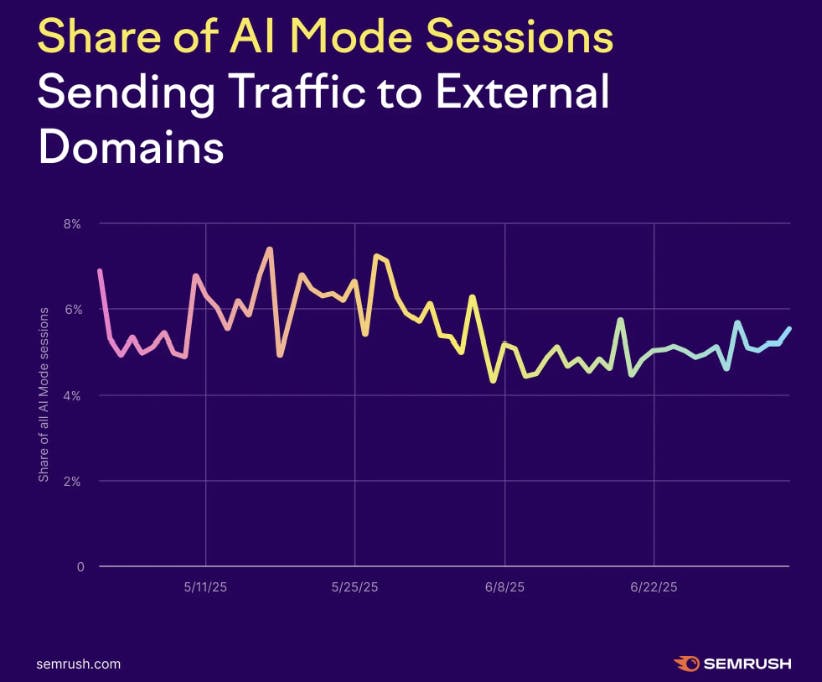
Image 1: Share of AI Mode Sessions Sending Traffic to External Domains, Source: Semrush
This does, however, not mean no shopper will ever visit your website.
The usage of AI Mode during the research phase results in the highest zero-click rates. The case is different with AI Overviews, although still troubling for D2C brands [2]:
- Without AI Overview: ~34% zero-click
- With AI Overview: ~43% zero-click
II. Conversational Commerce and AI Search
Once the shopper does visit your website (either manually or through an LLM recommendation), you can no longer rely on your old menus and filters. Your “lazy” shopper has got used to a conversation, with AI as a helpful assistant answering their queries no matter how they phrase them. Your website that relies on filters and menus creates a gap between their expectations and reality, causing you to lose a potential customer.
What is more, by coming to your website referred by AI, they are a high-intent customer. According to 2026 benchmarks from Exposure Ninja, traffic arriving via AI search tools converts at 14.2%, compared to just 2.8% for traditional Google organic search [3]. They are ready to buy. Your design and UX are what's stopping them.

Image 2: H&M Search functionality, Source: H&M
A user typing in “light woman’s suit for a summer wedding” doesn’t have a single result on H&M’s website. It’s highly unlikely that they don’t have a single match or that by searching manually you wouldn’t be able to find such a piece of clothing. This smart almost conversational inquiry should be understood by their search bar. Instead, all you see is “zero results”.
Moving your native website search bar from a basic keyword matching tool to a fully-integrated, fine-tuned, and intelligent AI-powered search is what will cause your visitors to stay. AI-powered search understands intent, sentiment, nuance, which is precisely what your shopper expects.
An intelligent store also goes beyond simply understanding the text inside the search bar. True alignment with the lazy shopper means your search interface must dynamically generate and render complete product pairings, tailored collections, or custom bundles immediately within the chat view. Presenting the exact look requested by the buyer removes the need for additional navigation, instantly bridging the gap between initial discovery and adding items to the basket.
The Zero-Click Checkout
Capturing the modern high-intent shopper requires a complete rethink of the final checkout step as well. Forcing a user through manual address fields and multi-page credit card forms introduces friction that destroys conversion momentum.
True conversion engineering requires the integration of biometric, one-tap digital wallets like Shop Pay and Apple Pay directly into your on-site conversational interface. Advanced stores are now implementing agentic payment protocols, including OpenAI's automated checkout pipes and Google's universal commerce frameworks. These tools allow consumers to securely finalise transactions using a single voice confirmation or biometric scan right inside the chat window, removing traditional checkout pages entirely from the purchasing flow.
Your Store in 2026
So, the question is: Is your D2C store engineered for the modern "lazy shopper," or are you letting high-intent, 14.2% converting traffic slip through your traditional menus and filters?
Your approach should be the following: analysing your current LLM positioning, whether you appear in answers or not. If you do, is the information provided correct? Are your product pages filled with enough information to answer any questions your target audience may have? Have you updated your UX in recent years? Do you still rely on multilayered menus, complex filters and traditional keyword-based search bars?
Can a shopper interact with your online store as if they were talking to a professional who will help them down their shopping journey, finding the perfect match for their needs, and more?
Ultimately, Zero-Click Commerce is not a trend that you can afford to sit out while waiting for search dynamics to stabilise. The data from Gartner, Semrush, and Adobe proves that consumer habits have fundamentally fractured, and the brands winning the margin battle are those building invisible infrastructure for LLM optimisation alongside conversational pathways on-site.
If your data remains trapped behind old structures and your checkout relies on manual data entry, your brand will simply disappear from the consumer consideration set entirely. Future-proofing your enterprise means turning your storefront into an elite, conversational destination that answers intent perfectly and executes transactions instantly.
FAQ
Frequently Asked Questions
[1] Gartner. "Gartner Predicts Search Engine Volume Will Drop 25 Percent by 2026 Due to AI Chatbots and Other Virtual Agents". Gartner Newsroom. 2024. http://gartner.com/en/newsroom/press-releases/2024-02-19-gartner-predicts-search-engine-volume-will-drop-25-percent-by-2026-due-to-ai-chatbots-and-other-virtual-agents
[2] Semrush. "Google AI Mode: The Future of Search and Its SEO Impact". Semrush Blog. 2026. https://www.semrush.com/blog/google-ai-mode-seo-impact/
[3] Exposure Ninja. "AI Search Statistics: How Generative AI Curation Impacts Organic Traffic Benchmarks". Exposure Ninja Marketing. 2026. https://exposureninja.com/blog/ai-search-statistics/
[4] Dmitrij Żatuchin. "Who Owns the AI Recommendation? A Multi-Industry Empirical Map of Brand Category Ownership Across Large Language Models". arXiv Systems. 2026. https://arxiv.org/abs/2606.23057
[5] Adobe Digital Insights. "2026 Q2 AI Traffic Report: Sourced Traffic Insights and Retail Trends". Adobe for Business. 2026. https://business.adobe.com/resources/sdk/2026-q2-ai-traffic-report.html
[6] Business Wire. "Riskified Study Finds Consumers Aren't Ready to Hand Over Control as AI Transforms Shopping". Riskified Ltd. 2026. https://www.businesswire.com/news/home/20260427900819/en/Riskified-Study-Finds-Consumers-Arent-Ready-to-Hand-Over-Control-as-AI-Transforms-Shopping-with-Over-Half-Afraid-of-Online-Fraud
[7] S. Shivani Mohan. "How AI Mode is changing the way people search in the U.S.". Google Product Blog. 2026. https://blog.google/products-and-platforms/products/search/ai-mode-us-insights/
[8] McKinsey & Company. "The Evolution of Search: Generative AI and Consumer Discovery in 2026". McKinsey Digital. 2026. https://www.mckinsey.com/capabilities/mckinsey-digital/our-insights/the-evolution-of-search-generative-ai-2026
[9] SparkToro. "The 2026 Zero-Click Search Study: Clickstream Data and the Decline of the Referral Link". SparkToro Blog. 2026. https://sparktoro.com/blog/2026-zero-click-search-study
[10] BrightEdge Research. "Generative Engine Optimization (GEO): Measuring Product Citation Uplifts via Structured Data". BrightEdge Reports. 2025. https://www.brightedge.com/resources/geo-structured-data-report-2025
[11] Capital One Shopping Research. "Retail Chatbot Adoption and Consumer Product Discovery Trends". Capital One Research. 2026. https://capitaloneshopping.com/research/chatbot-product-discovery-trends/
[12] H&M Group. "AI-Powered Semantic Search & Multi-Modal Curation Interfaces". H&M Tech. https://hmgroup.com/technologies/semantic-search-interface
[13] Shopify Engineering. "The Universal Commerce Protocol: Scaling Agentic Payments and Conversational Checkout Elements". Shopify Plus Insights. 2026. https://www.shopify.com/enterprise/universal-commerce-protocol-agentic-payments
[14] Position Digital & Growth Memo. "LLM Citation Retrieval Distribution: Content Scannability and Entity Extraction Dynamics". Position Digital Analytics. 2026. https://positiondigital.com/insights/llm-citation-retrieval-distribution