



How to Win Customers Back from AI & LLMs
Learn how to turn LLMs into discovery filters while building a "High-Fidelity" website that converts. We detail the 15 technical and strategic reasons why your owned channel wins at retention, configuration, and trust.
In one of our latest pieces, we discussed whether it could pay off to exclude yourself from the LLMs’ discovery and purchase journeys to avoid paying the potential (and newly introduced transaction fees) and to retain customers on your own website.
The issue with excluding yourself from these channels is, however, not as simple as saving money on not paying the transactional fee.
In short, what we discussed is that the 4% fee introduced recently by OpenAI should be seen only as a fee you pay for the acquisition. Just like with any other channel you may be using to reach your potential customers.
However, it is crucial to highlight that LLMs like ChatGPT, Gemini, or Perplexity are most certainly not “just any other channel.” The sheer volume of visitors they receive each month (which is also growing rapidly on a monthly basis) proves that you can no longer afford to rely on being found on Google search exclusively, or even via paid ads.
In fact, the statistics show just how much attention you should give to LLMs as a retailer. As of early 2025, retail keywords triggering AI Overviews (SGE) have increased by 206%, while organic click-through rates for those same queries have plummeted by as much as 61% (Seer Interactive, 2025).
But, if you do stay indexable to LLMs, you may rightfully wonder: other than the very purchase you get, how can you, as a brand, and how can your own website stay relevant?
AI as the New Commerce Funnel
The number one danger you may see coming from AI is that it will take over all your purchases. It is not a completely unrealistic scenario.
However, given the very nature of human trust, and the fact that this is a fairly new kind of shopping, no matter how willing the customers are to let AI complete their purchases, they are ready to do so with some, and still quite large, limits.
What we mean by this is the following: LLMs will likely replace your store for smaller, "commodity" purchases due to one crucial factor: trust.
If a customer needs to reorder the same coffee pods or a basic white t-shirt, they will be more likely to do it via a chat interface. It’s a simple purchase with little risk, and what AI offers in this case is of bigger priority to the shopper, and that is a frictionless journey.
For you, the founder or CMO, paying that 4% "agentic tax" is a win - you got the sale. It may seem like a large percentage, but it’s still a lower CAC than most Meta or Google Ads campaigns today.
However, you are currently facing a much larger internal fire. While you worry about OpenAI taking 4% (and retailers seem to be focused on the percentage itself), you are likely already losing 86% of your mobile visitors to cart abandonment (SellersCommerce, 2025). Moreover, mobile web conversion sits at 2.1% compared to 3.5% on desktop (Marketing LTB, 2025).
The strategy isn't to block the bots.
The strategy is to fix your house so that when a customer wants something complex, something expressive, or something exclusive, the LLM has no choice but to send them to you.
A simple T-shirt purchase should be seen as a simple sale. You pay the fee and get your sale. More complex and repeat purchases and experiences is where you should step up your game.
15 Reasons Your Website Will Remain Customer Target
To stay relevant and not disappear in the agentic commerce age, your website must do what a text-based LLM cannot. We’ve categorised the 15 pillars of a "post-search" website into three strategic buckets.
I. The Technical Edge
When a purchase requires more than a text confirmation, the LLM fails. This is where your engineering team creates the moat.
1 - AI-Powered Site Search
Generic LLMs are "wide." Your site search should be "deep." Implementing semantic search can lead to a 3x conversion lift because it understands the nuance of your specific catalogue better than a generalist bot (Algolia, 2026).
You are the one in charge of the information it provides to your own customers, and your own AI-powered search can offer customers visiting your website a far superior, more detailed, concrete and factually correct information on everything from orders, privacy policies, returns and payments, to actual and up-to-date information on goods storage.
2 - Product Configuration
A chatbot can't help a user build a modular home office or customise the thread count and colour of a bespoke suit. A complex 3D configuration is a "direct-only" experience you offer your customers if they visit your website.
A great example of this is Burrow. Their modular sofa customizer allows users to visualise layouts and fabrics in a way a text-based bot never could, turning a "commodity" furniture purchase into a personal design project.

Image 1: Sofa Customiser, Source: Burrow.com
3 - AR Try-On & Visual Discovery
Over 62% of Gen Z now prefer visual search tools over text (Marketing LTB, 2025). If you can show them how a pair of glasses looks on their face using AR, the LLM, which is, in this case, simple and limited, becomes irrelevant for the final decision.
Visual, as well as voice search tools, are no longer seen only as commodities, as the new generation of customers uses them on a daily basis all over the internet, and expects to do so as a part of their customer shopping journeys as well.
Warby Parker uses a "Virtual Try-On" tool that leverages TrueDepth cameras to render glasses on your face in real-time. This visual certainty is something a text box cannot replicate.

Image 2: Virtual Try-On, Source: Warby Parker
4 - Frictionless UX & Biometrics
Mobile shoppers are impatient. If you create a shopping experience that works only on desktop, expecting shoppers to come back later, you will lose them. Currently, mobile cart abandonment rates are nearly 10% higher than desktop (SellersCommerce, 2025).
Sites using "One-Click" biometric checkouts see significantly lower abandonment. If your site is faster than a chat interaction, you win.
5 - Conversational Commerce Agents
Don't let ChatGPT be your only salesperson. Once a shopper does visit your website, trained to and used to simple frictionless interactions with LLMs, you have to match that same experience.
What is more, your own on-site AI agents, trained on your brand voice and real-time inventory, can and should provide a superior service experience to any other outside agent.
II. The Trust Infrastructure
In an era of "AI Hallucinations," your website is the legal and emotional anchor for the customer.
6 - Authenticity & Source of Truth
70% of Gen Z consumers worry about trusting what they see or hear due to AI (Attest, 2025). We have all been using AI long enough to actually know how easily it can fabricate information, and with what level of confidence.
Your site is the only place they can verify technical specs, warranties, and certifications. Your bot needs to make no mistakes when it comes to conversations, let alone more complex agentic actions.
7 - Direct Pricing
This is your strongest lever. By shopping directly, customers avoid the "Agentic Tax." You can pass those savings back to them, ensuring the LLM is used for discovery, but the transaction happens with you.
8 - Community & Social Proof
LLMs can summarise reviews, but they can't replicate the feeling of a community forum or a feed of real user-generated videos (UGC).
Glossier has built its entire growth engine on UGC and peer referrals. Their site serves as a social hub where customers see "real people" using products, creating a level of social proof that AI summaries lack.
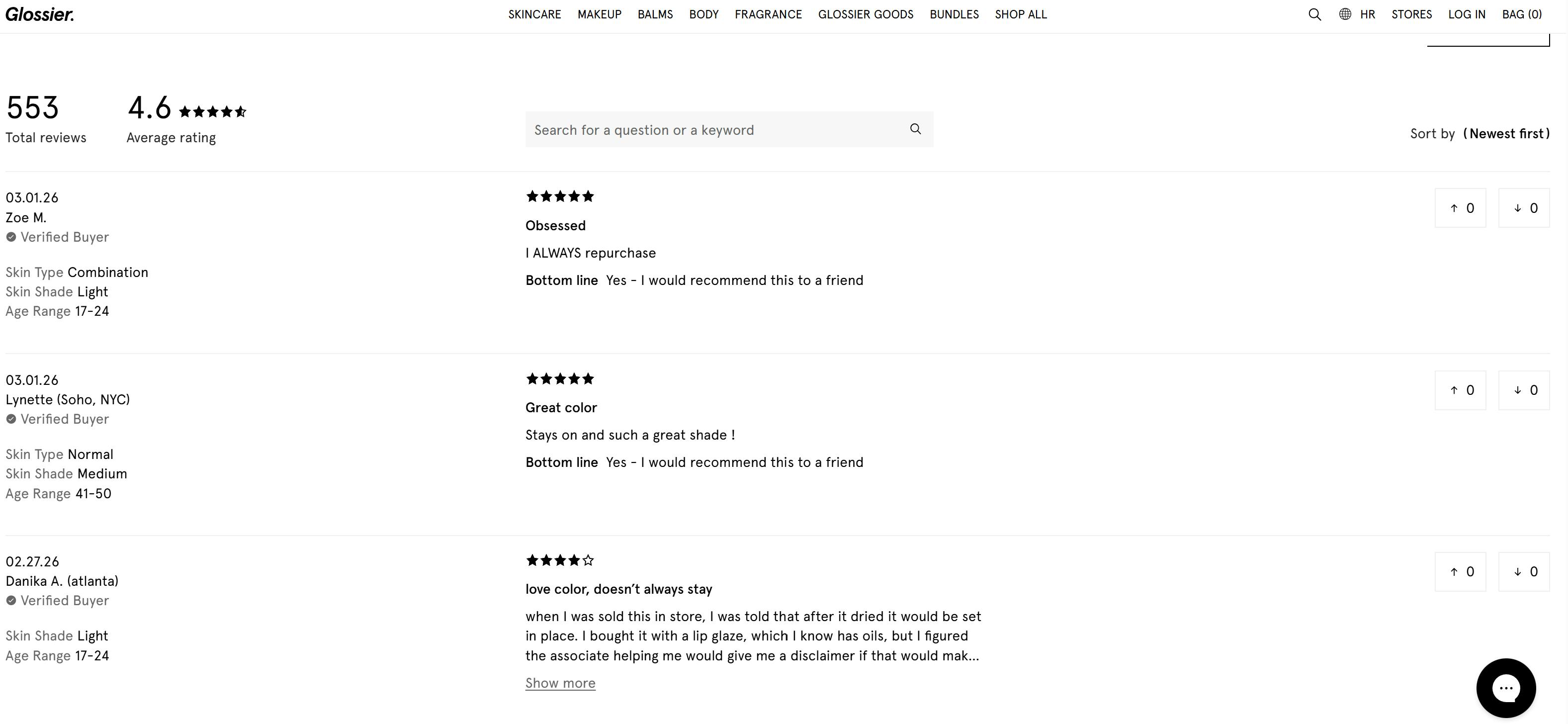
Image 3: Social Proof, Source: Glossier
9 - Ethical Alignment
Your B-Corp status or sustainability journey requires deep storytelling. A bot will summarise it into a bullet point. Your website makes them feel it.
Patagonia uses its Footprint Chronicles to provide radical transparency into its supply chain, featuring maps and environmental assessments that prove its mission is more than just a marketing slogan.

Image 4: Patagonia Stories, Source: Patagonia
10 - Logistical Mastery
Managing complex shipping (white-glove delivery) or seamless international returns is a backend feat that a chat interface simply cannot coordinate effectively yet.
III. The Experience Layer
Retention happens in the "vibe," not in the transaction.
11 - Brand Storytelling
Use rich, immersive video and "World-Building" content. You want customers to browse your site like they browse a magazine, not a database.
Tracksmith produces original films and photography that capture the "culture" of running. Their site is a destination for inspiration, not just a place to buy shorts.

Image 5: Tracksmith Brand Building, Source: Tracksmith
12 - Hyper-Personalisation
While an LLM knows what "people" like, your site knows what this person likes based on years of first-party data. Personalisation can raise revenue per visitor by 19% (Marketing LTB, 2025).
Stitch Fix uses billions of data points to create a "Vision" gallery for each user, predicting what you’ll love before you even search for it.
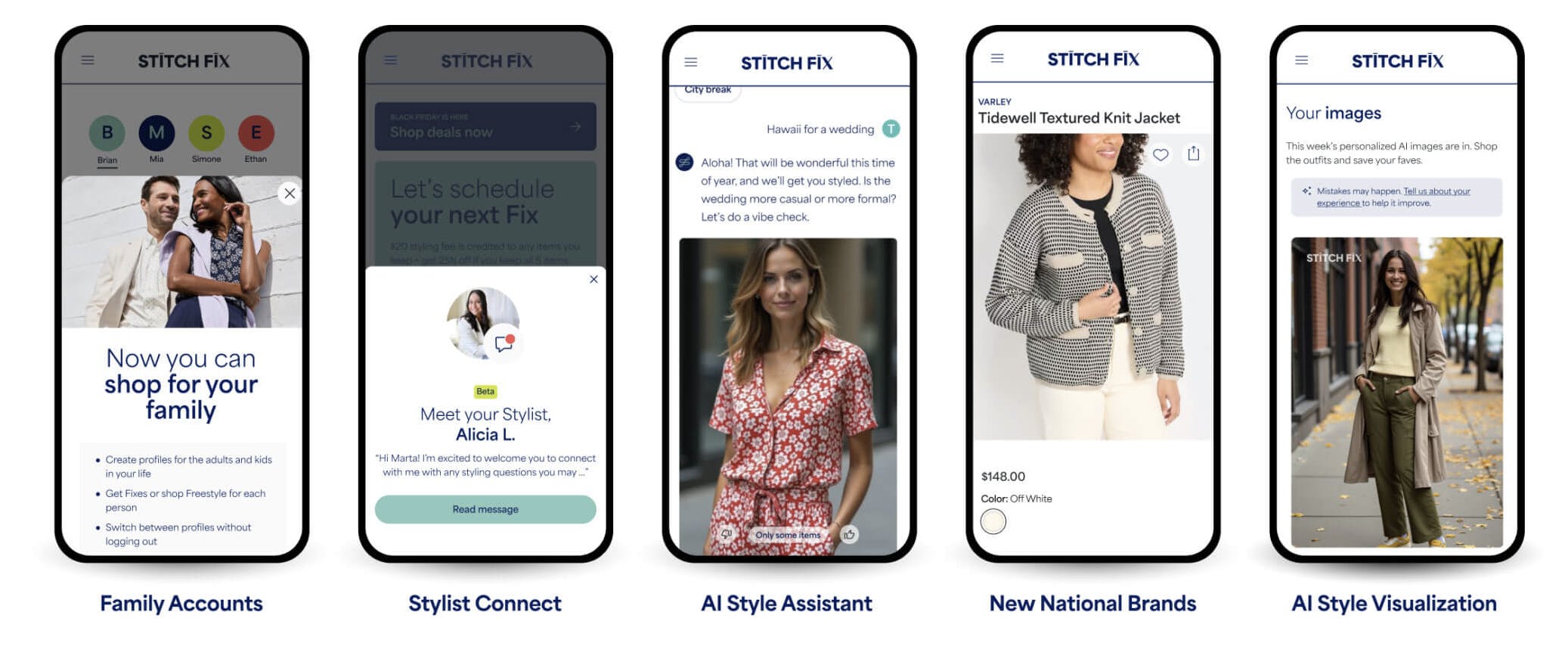
Image 6: Stitch Fix's Hyper-Personalisation Journey, Source: Stitch Fix
13 - Loyalty & Rewards
VIP tiers, "Streaks," and early access to drops are the "hooks" that make a customer ignore the AI's suggestion and type your URL directly into the browser.
14 - Sensory Experience
High-definition 360-degree views and "lifestyle" videos provide the weight and texture of a product that text descriptions can never replicate.
15 - Exclusive Access
Use your site for "Members Only" launches. If the LLM can't see the inventory, it can't sell the inventory.
Telfar uses its "Bag Security Program" to manage hyper-demand. By restricting access to their own site for these events, they ensure they own the relationship with their most valuable fans.
How to Get the Customer to Shop Directly from You
If a customer finds you through an LLM and you pay the 4% fee, don't view it as a lost margin. View it as a sample.
The goal of that first AI-originated purchase is to use the physical delivery to "onboard" them to your direct channel using two simple but powerful techniques:
- Build your brand through the completed transaction
Since you are the Merchant of Record, you own the post-purchase emails. While you cannot "spam" these users with marketing, you can send high-value transactional updates. Don't just send a simple receipt, but use the opportunity to start a conversation with them by sending a branded experience with "How-to" videos or a "Meet the Maker" story. Use the 114% open rate of these emails to prove your brand's "vibe" is worth a direct visit. - Win them over with additional offers
You own the physical unboxing experience. Every package should include a physical "hook" to move the customer to your owned list. This could be a QR code that unlocks an AR experience on your site or an exclusive invite to a loyalty program that offers "direct-only" pricing.
You use the LLM to find the customer, and you use your website to keep them.
Conclusion
The "Agentic Tax" is only a threat to brands that have nothing to offer but a product. If your website is just a list of SKUs and a "Buy" button, you are effectively a commodity, and the LLMs will get all your customers. You will pay the transaction fee and, no matter its percentage, it will not be cheap for you.
In fact, if the customer doesn’t ultimately reach your website for the superior experience, every time they visit an LLM searching for something, you will pay a separate transaction fee. In that case, it won't even be an acquisition fee, as you are paying it multiple times for the same customer. Worse yet, the LLM may lead the customer to a completely different brand once they return for another purchase, so you risk losing a new purchase as well.
But if you treat your website as a high-fidelity destination, a place of 3D configuration, deep community, and biometric speed, the LLM becomes your most effective marketing partner. It handles the "boring" discovery and sends the high-intent fans to your door.
Is your technical stack ready for the post-search era?
Most DTC brands are losing more money to mobile friction than they ever will to AI fees. We can help you identify the "High-Fidelity" gaps in your current experience.
Frequently Asked Questions
1. If the AI completes the purchase, do I still "own" the customer data? Yes. When a transaction occurs via an LLM’s "Instant Checkout," the AI acts as the front-end interface, but you remain the Merchant of Record. The order is pushed directly into your backend (e.g., Shopify or Magento) with the customer’s name, shipping address, and email. However, there is a catch: you get the data for fulfilment, but not for marketing consent. You will see their data, but you cannot automatically add them to your newsletter.
What are your options?
- Optimise your transactional emails by using your shipping and order confirmations (which have the highest open rates) to showcase your brand and link to your site.
- Include a physical insert or QR code in the package that offers a discount or VIP access if they sign up directly on your website.
2. How do returns and customer service work for AI-originated orders? LLMs are designed to handle the "status check" (e.g., "Where is my order?"), but they aren't equipped for physical logistics. For returns, the AI will pull your policy from your site's metadata and then provide a Direct Link to your return portal. This is actually a strategic advantage: it forces the customer back into your "High-Fidelity" ecosystem, where you can offer exchanges or loyalty points to save the sale.
3. Does blocking AI crawlers (GPTBot, etc.) protect my brand exclusivity? Blocking crawlers is often a "scorched earth" tactic that backfires. In 2026, being invisible to an LLM doesn't make you exclusive. It makes you non-existent to a generation that uses AI as their primary lens for the world. A better strategy for luxury or exclusive brands is to allow indexing of your Brand Story and Core Collection, but keep your "Limited Drops" and "Member-Only" inventory behind a login that AI cannot crawl.
4. Will my on-site AI Agent conflict with the customer’s personal AI Agent? We are entering the era of "Agent-to-Agent" commerce. Your on-site agent acts as the Expert (knowing your real-time inventory and technical specs), while the customer’s personal AI acts as the Advocate (knowing their budget and preferences). By building a technically sound, machine-readable website, you are providing the high-quality data it needs to recommend your brand over a competitor.