




Q1 2026 report · Free PDF
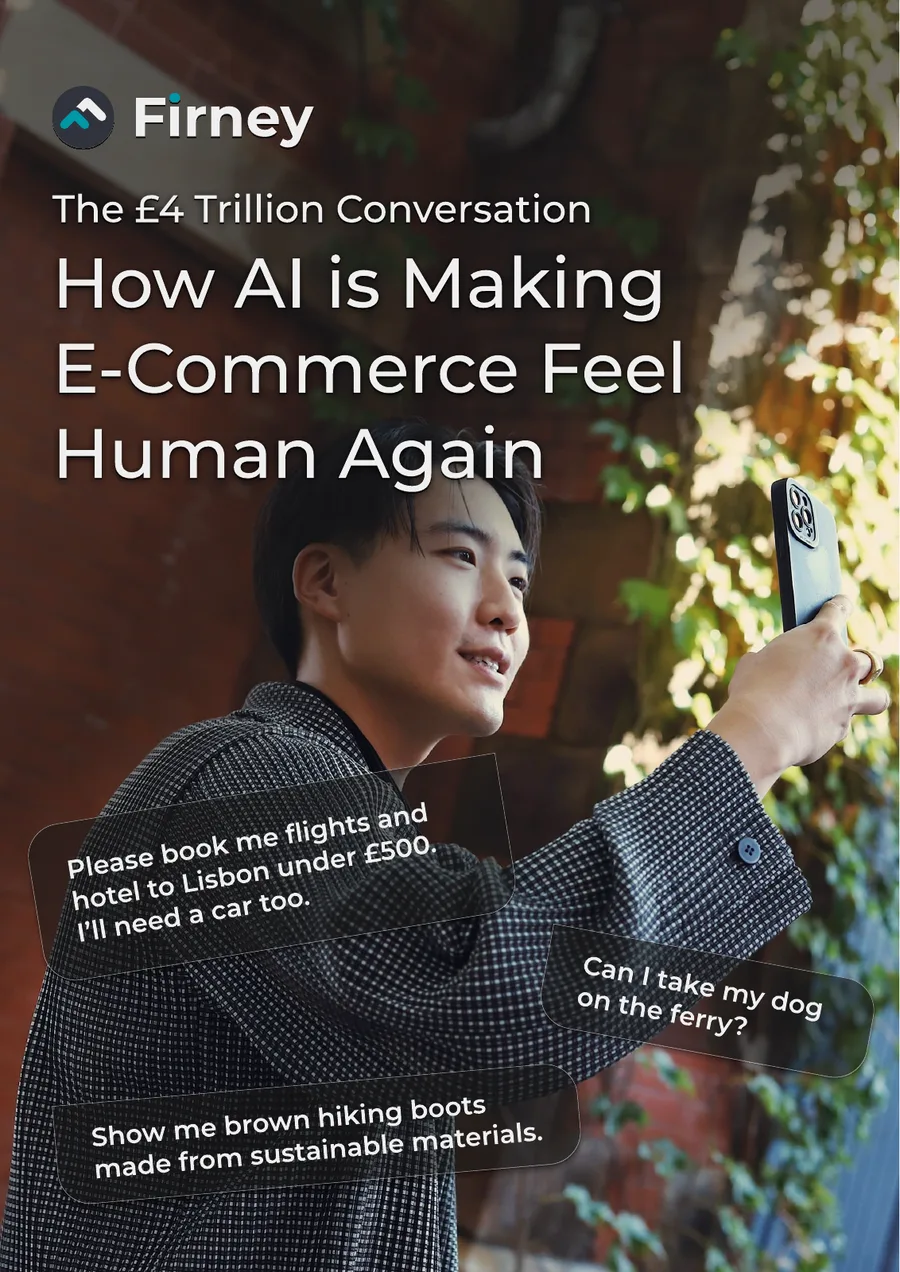
The £4 Trillion Conversation
How AI is Making E-Commerce Feel Human Again
Published by Firney,
24 pages · No form, no email needed
90%
of B2B buying will be AI-agent intermediated by 2028 (Gartner)
3x
higher conversion rate for users who engage with AI-powered search (Commercetools)
43%
of Gen Z start product searches on TikTok (Connect Media)
14%
trust AI for autonomous purchases
Key findings
As of January 2026, the traditional e-commerce playbook is obsolete. Here are the five takeaways from our report.
The discovery model is broken
Twenty years of forcing consumers to “speak machine” through keywords has hit diminishing returns. Incremental UX optimisation no longer creates real value.
Gen Z demands conversation, not search
43% start product searches on TikTok, 62% prefer visual search, and they’re “experience-loyal.” They ask “How do I fix it?” not “Best mountain bike chain lube.”
AI agents deliver measurable ROI
Klarna’s AI handles 2/3 of customer service chats, doing the work of 700 agents and driving £32M in profit improvement. Users engaging with AI-powered search convert at 3x higher rates.
Trust is graduated, not binary
65% trust AI for price comparison, 44% for product recommendations, but only 14% for autonomous purchases. Transparency (like Stitch Fix’s approach) can increase AOV by 40%.
2026 is the year of “zero-click” commerce
By 2028, 90% of B2B buying will be AI-agent intermediated. Brands need machine-readable data and real-time inventory APIs, or their agents will “hallucinate.”
The shift from answer engines to action engines
We stand at the precipice of a £2.4 trillion to £4 trillion (~$3T to $5T) global shift in revenue orchestration (McKinsey). AI is no longer a tool for information retrieval; it is a workforce for execution.
- The workforce redefined: In sectors like fintech, single AI assistants now handle the workload of 700 full-time human agents, slashing resolution times from 11 minutes to 2 minutes (Klarna).
- The visual imperative: Traditional search volume is predicted to drop by 25% by 2026 as consumers migrate to multimodal interfaces (Gartner). “Camera Natives” now expect to search with images, not words.
- The infrastructure of autonomy: 2026 is the year of AP2 (Agent Payments Protocol) and ADK (Agent Development Kit). We are moving toward “Zero-Click” shopping where agents both request and fulfil complex shopping requirements and replenishment loops autonomously.
The journey from “researchers” to “impatient discoverers”
Phase 1: The indexical era (2000–2023)
We taught humans to speak “machine.” We forced consumers to break their desires into keywords. We built SEO strategies to rank for fragments, and the burden of synthesis lay entirely on the user.
Phase 2: The generative interlude (2023–2025)
We introduced chatbots, but they were largely “polite librarians.” They could summarise text and retrieve information, but they were reactive. If the user stopped typing, the value stopped flowing.
Phase 3: The agentic era (2026 and beyond)
We are moving from “finding” to “fixing.” The new paradigm is “Agentic Commerce,” where systems reason, plan, and execute workflows to solve complex user needs.
Old playbook vs. new reality
A structural comparison of the old way (rigid) and the agentic way (fluid).
B2B qualification
The old way (rigid): Static forms; Typical 42-hour wait.
The agentic way (fluid): Instant agentic qualification.
B2B discovery
The old way (rigid): Keyword guessing; paginated product grids.
The agentic way (fluid): Understanding the “intent” or “vibe.”
Search mode
The old way (rigid): “Rusty window track.” (Passive)
The agentic way (fluid): “How do I fix a stuck window?” (Active)
Retention
The old way (rigid): Fixed “set and forget” subscriptions.
The agentic way (fluid): AI-driven Predictive Replenishment.
Lead generation
The old way (rigid): Extracting data via gates.
The agentic way (fluid): Building trust via consultative dialogue.
Outcome
The old way (rigid): High abandonment; “0 results.”
The agentic way (fluid): +30% to +40% CVR lift via Visual Search.
Redefining performance benchmarks
In the conversational economy, traditional metrics like click-through rates are becoming vanity metrics. The new benchmarks are rooted in interaction quality and outcome efficiency.
340%
The increase in repeat purchase revenue achieved by brands switching from generic reminders to AI-backed predictive schedules.
Source: Replenit
217%
The increase in engagement when personalisation is driven by AI that understands a customer’s stated needs.
Source: Singlegrain
3x
The higher conversion rate for users who engage with AI-powered search compared to those who do not.
Source: Commercetools
60%
How much more likely users of generative shopping assistants (such as Amazon Rufus) are to purchase compared to non-users.
Source: Core Blueprint
£32 Million
The estimated annual profit improvement driven by a single integrated AI assistant in the fintech sector.
Source: Klarna
78%
The reduction in return rates achieved by guiding B2C customers to the right product the first time via conversational consultation.
Source: Retainful
The Gen Z paradigm: winning the “impatient discoverer”
To win the fastest-growing customer segment, we must recognise their unique psychology. They don’t want to describe a look; they want to show it.
Social-first discovery
43% of Gen Z start product searches on TikTok rather than Google (Connect Media). They value “Social Listening” and cultural relevance over statistical popularity.
The camera is the keyboard
62% of Gen Z and Millennials prefer visual search over any other retail technology (Visual Search vs. Text Search Strategy).
The search-to-spend ratio
Users who interact with site search spend 2.6x more than those who simply browse (Algolia).
The trust paradox
They are the most willing to use AI (70% use AI tools for shopping), yet the most demanding of transparency. While 32% of Gen Z are comfortable with agents making purchases, only 12% fully trust it without oversight (GetCoAI).
Navigating the trust gap
Adoption is a gradient that shifts based on the risk profile of the task.
High trustAnalytical support: Tasks like price comparison across stores are viewed as objective and verifiable.
65%
Moderate trustAdvisory services: Subjective territory like product recommendations where “hallucination anxiety” lingers.
44%
Low trustExecutive agency: Authorising an agent to place an order without human supervision.
14%
Want to know how AI assistants see your site?
Results in a few minutes
2026 forecasts
By 2027, the primary interface for many brands will be an API called by a bot, not a screen viewed by a human.
- 90% AI intermediated: 90% of B2B buying will be AI-agent intermediated by 2028 (Gartner).
- Zero-click shopping: Predictive replenishment models will manage recurring household and business needs without manual input, driven by cryptographic AP2 Mandates.
- Death by AI liability: We expect over 2,000 legal claims regarding AI “hallucinations” (like the Air Canada precedent) by the end of the year (Gartner). Governance is now a marketing issue.
- The service “dip”: Forrester predicts that overall customer service quality will paradoxically dip in 2026. “Faithfulness”, the AI’s ability to ground responses in verified source documents, will become a primary CMO KPI. Target a score of 0.95+ to prevent brand damage (Ragas).
Your 2026 investment checklist
Understand the intent of the search
Capture the intent of customer searches through natural language querying and conversation on-site.
Clean your data lake
You cannot build a concierge on fragmented data. If your inventory APIs aren’t real-time, your agent will hallucinate.
Invest in visual asset transformation
Shift budget from copywriting to visual creation. Your images are your new keywords. Optimise them for machine vision.
Implement “zero copy” architecture
Enable AI to access live data without moving or storing it in a new location (Salesforce).
Agentic optimisation (AO)
Ensure your pricing and specs are machine-readable so personal agents can “index” and buy from you.
Response grounding / faithfulness
Ground responses in verified source documents. Target a score of 0.95+ as a CMO KPI to prevent brand damage.
Read the full report
The full report covers the evidence and sources behind every figure here, with sector spotlights on retail, travel, finance and B2B, and executive perspectives from Klarna and Stitch Fix.
Related reading
- Amazon’s 35% revenue from recommendations: the full data
What the figure behind Amazon’s recommendations means for your own store.
- AI content recommendation
How we put the right product or content in front of each visitor.
- AI website search
How we turn your site search into a conversation that understands intent.
Thinking about what this means for your site?
We’re happy to talk through where conversation, search and recommendations could help your customers find what they need.