




Website Personalisation: What It Is and How to Implement It
Learn how AI-powered personalisation drives a 10-15% revenue lift. Move beyond static segments to real-time intent and boost conversions by meeting modern user needs.
When it comes to retail, travel, entertainment, or food, most websites still treat you like a stranger once you visit them. You open their homepage and receive an experience that is virtually identical to every other visitor they get.
If you’ve visited their website before, or logged in, they may recognise you and call you by your name. They may even suggest future purchases based on what you browsed or bought before. But in the AI era, this "static" personalisation feels like an echo of the past. Greeting a customer by name while showing them products they bought six months ago, or similar products others have bought, isn't doing much in anticipating their needs or understanding what they need right now.
This was acceptable before. However, today, things have changed, the first one being the major and sudden technological advancement led by AI, and the second one being user behaviour, with the two being obviously interrelated.
The most important signal here is that customers want personalised experiences, driven by their current intent, not their history or other users. This is what AI gave us, and the behaviour it taught us: almost every interaction with AI is personalised, custom, and revolves around what we want right now.
However, while 71% of consumers expect brands to anticipate their needs, only 34% of brands actually deliver, according to Adobe AI and Digital Trends report from this year.
The industry is essentially collecting mountains of data, storing it in different systems, and then showing everyone the same hero banner. As a result, US CX quality fell to an all-time low of 68.3 out of 100 last year.
The question isn't whether you know your customer's name. It's whether your site knows why they are here today, which is what we will guide you through in this blog post.
What is Website Personalisation
Very simply put, it is creating a custom experience for every website visitor based on particular data and signals given by that customer.
However, when it comes to a more detailed explanation of what website personalisation really is today, it is important to highlight that it has changed drastically over the years.
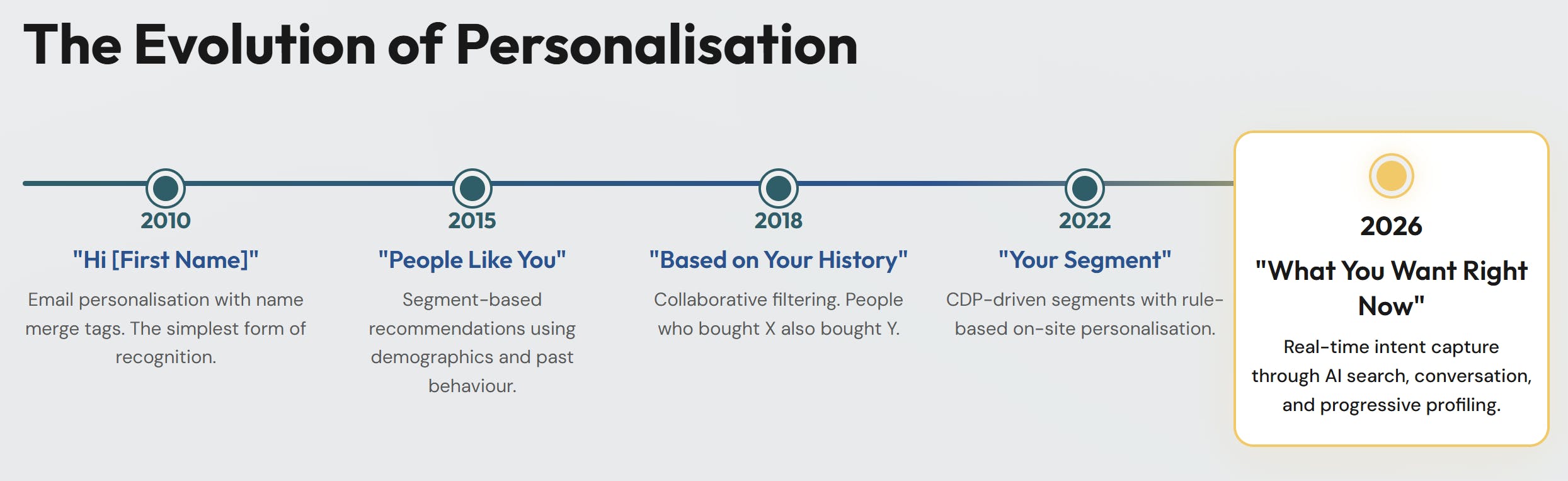
Image 1: The Evolution of Website Personalisation
Unfortunately, what we usually encounter presenting itself as personalisation are “old” forms of it, i.e. “People like you also bought”, or “Based on your history, you might like this”, or suggestions based on segmentation.
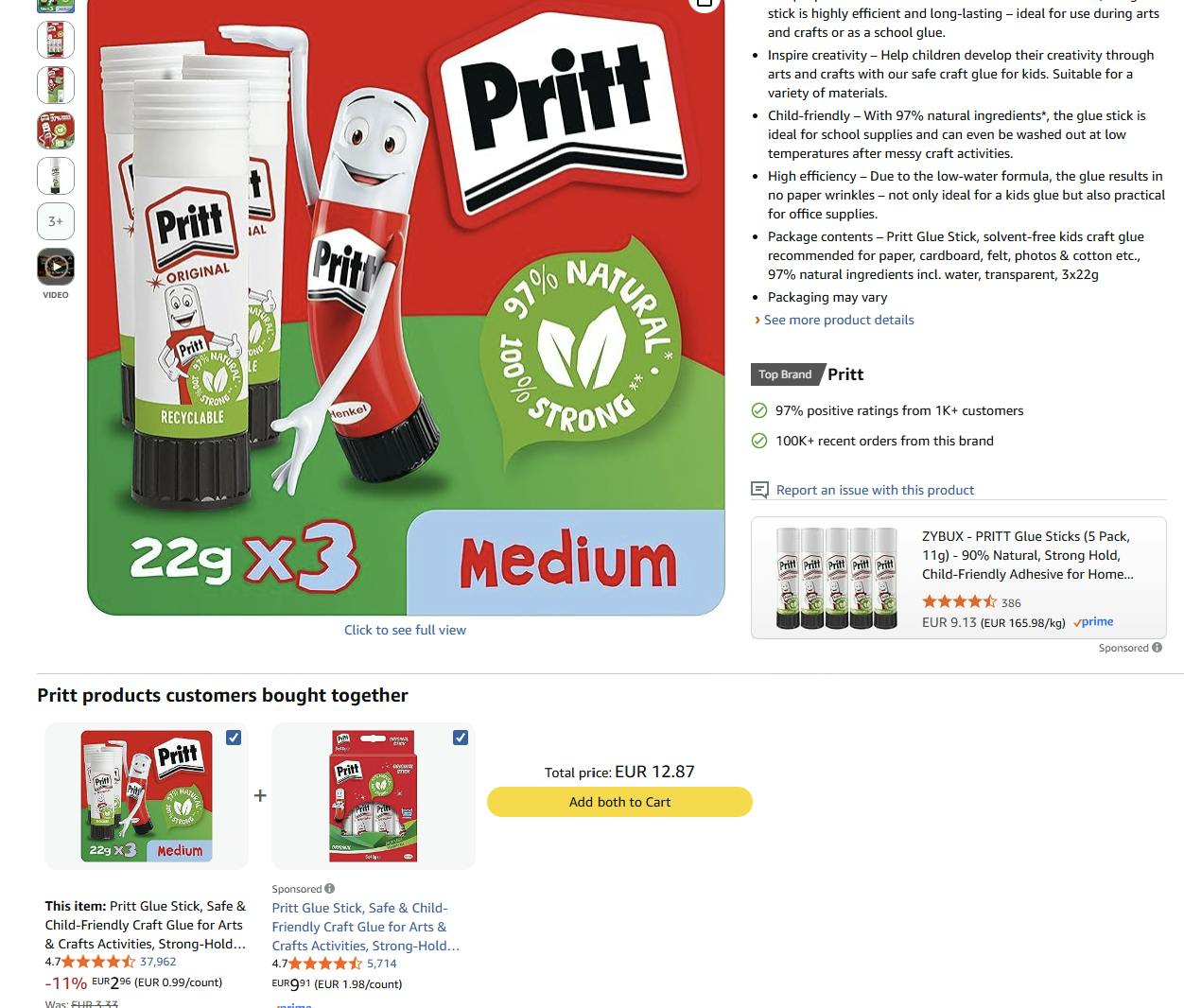
Image 2: Amazon’s “products customers bought together”, Source: Amazon.co.uk
Amazon’s “customers who bought this” drives 35% of their revenue, but lucky for them (and smart of them), this is just one of the options they offer when it comes to personalisation.
Let’s look at the modern AI-powered personalisation, again using the example of Amazon.
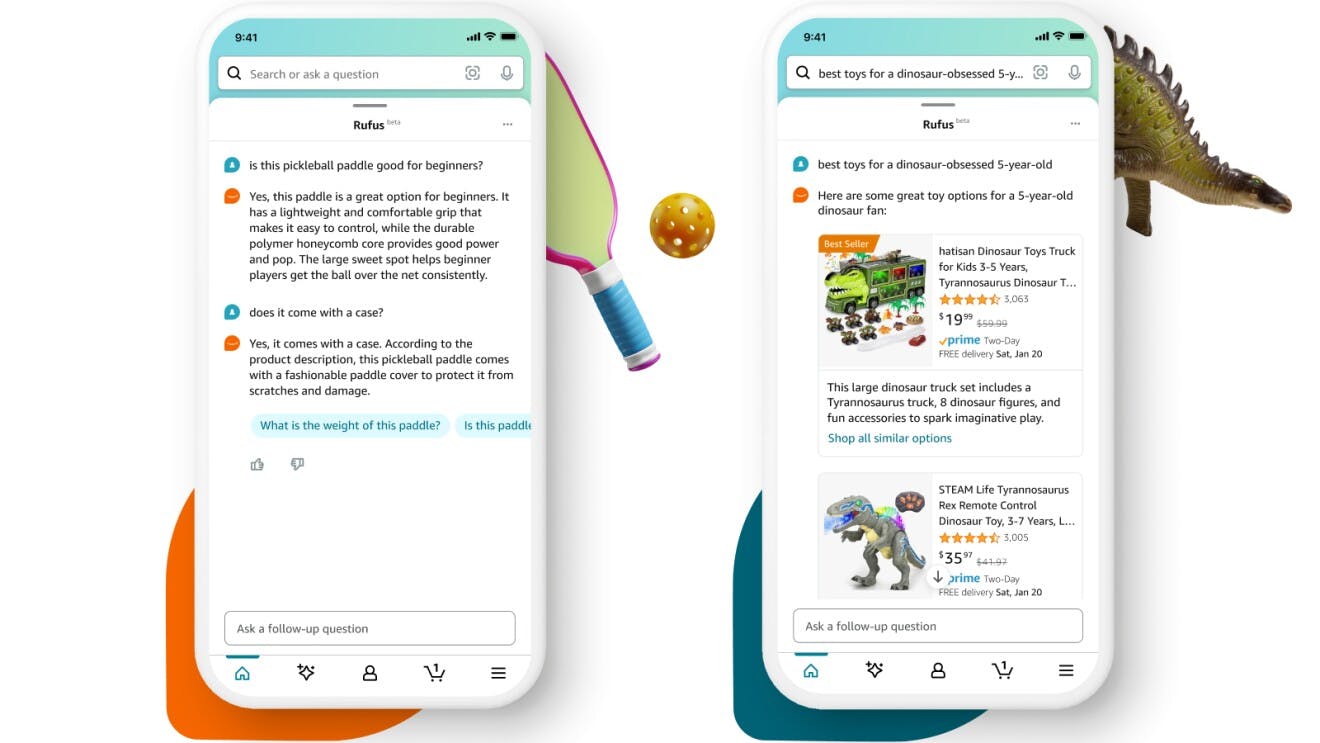
Image 3: Amazon’s Rufus, Source: About Amazon
Amazon's Rufus uses artificial intelligence to understand a customer. The tool acts on the words a person types into a search bar. It can suggest gear for a specific trip or answer questions about a product. This happens in real time during a single visit, with the tool shaping its understanding of what the customer needs in real time.
Modern systems like this handle intent during the actual session. Rufus builds a profile as a person chats. It scans product details and reviews to answer specific questions, like if an item is durable for a beginner. It tailors the shopping journey to unique concerns in that exact moment.
This marks a shift from traditional keyword searching to an intent model. It moves away from guessing based on what a person bought months ago. Amazon starts listening to what a customer is trying to achieve today. This helps a person find the right item faster, and what personalisation today is all about.
Why Website Personalisation Matters
The importance of personalisation is deeply rooted in user expectations, which are based on the experience and interactions they have in other places, particularly in interactions with AI.
Again, very simply put, if a customer receives a personalised experience, they are more likely to convert. But the scale of that conversion is what separates the market leaders from everyone else.
Research from McKinsey shows that the fastest-growing companies drive 40% more of their revenue from personalisation than their slower competitors. When you get it right, you aren't just "being helpful". You may be helping your customers understand your products better, or even guide them to what they didn’t even know they needed, but what you are ultimately achieving is a 10–15% lift in total revenue.
This isn’t just a fun conversation they are having with your agent, but a direct hit at your website’s success.
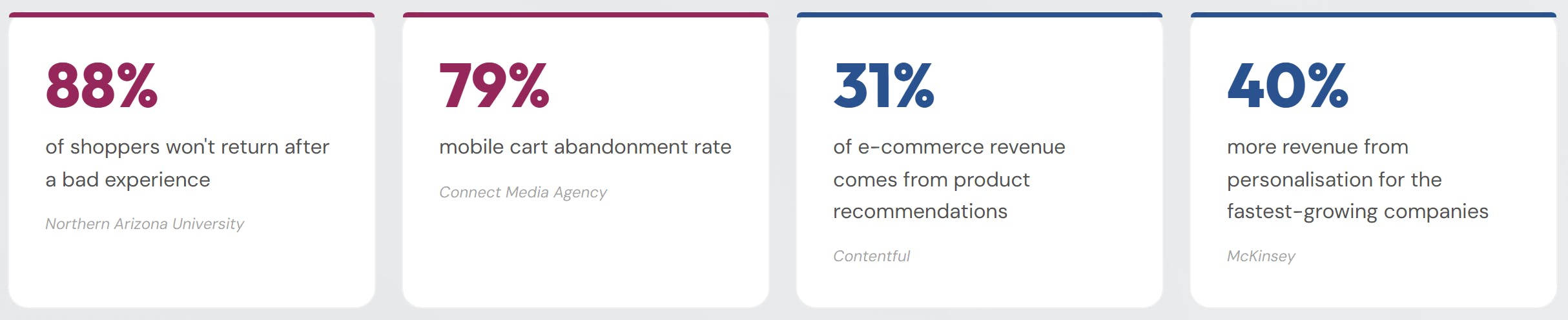
Image 4: Importance of Website Personalisation Data
Latest figures from Contentful suggest that personalised recommendations alone can account for up to 31% of e-commerce revenue.
This means that nearly a third of your revenue is directly influenced by whether your site actually understands what a visitor wants in the moment, or whether it makes them do the hard work of digging through your catalogue to find it.
Customers today no longer want to or have the patience to waste time on browsing and filtering, which is why you are risking high bounce rates, low Average Order Value (AOV) and loss of revenue. And all because you may not be properly using the data you already have at your disposal, or the data the customers would be willing to give you.
Typical enterprise brands gather information from around a dozen different sources. These include website visits and purchase records, along with email clicks and search terms. Companies also track loyalty points and support requests or social media interactions. Even though this vast amount of data is available, it usually stays locked within separate and disconnected software tools.
Why Websites Struggle with Personalisation
A typical business collects data from up to twelve different sources.
This information usually stays in separate silos like a CRM or a support platform. Because these systems are not connected in real time the website cannot see what a customer is doing right now. The site ends up guessing based on old data instead of acting on current behaviour.
Data Silos and Real-time Integration
The core issue is not that these separate systems do not communicate, but that they don't do it instantly.
A search platform might know what a visitor wants today, but the website cannot see that intent because the data is stuck in a silo.
Less than half of businesses feel their data is good enough for AI tools to use effectively. Because these connections are missing, websites end up guessing what a customer needs instead of using the information they already have.
Third-Party Cookie Restrictions
Privacy changes have also made traditional tracking much harder for brands.
Most personalisation tools were built to rely on third-party cookies. However, reports from Decentriq show that up to 70% of users now deny these cookies when asked, while some browsers automatically block them for their users (e.g. Safari).
Many companies are still trying to use tracking logic from several years ago. This does not work with modern data constraints. It leads to a drop in personalisation accuracy that matches the drop in tracking capability.
Customer Segmentation and Static Rules
Another major issue is that standard segmentation is too broad to be useful.
Brands often group thousands of people into one category based on age or location. Two people in the same segment often have completely different needs during a visit, even though a website's segmentation rules may put them in the same ‘box.’
For example, two visitors may both be females, 25-40 years of age, located in the UK, thus belonging to the same segment.
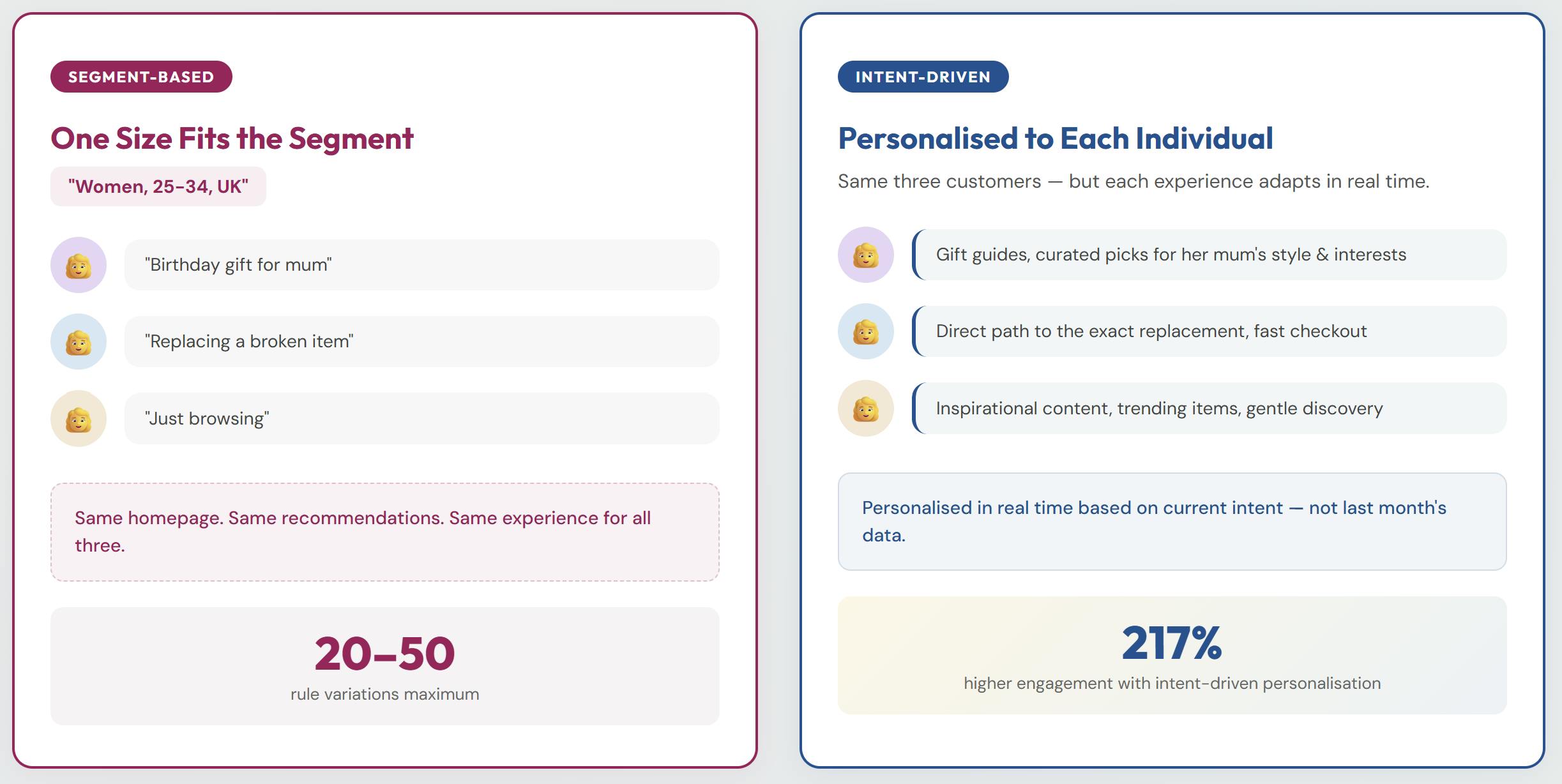
Image 5: Segmentation vs Intent
However, one might be looking for a gift while the other wants to replace a broken item. And if they are both looking for an item to buy for themselves, their budgets, the occasion they are buying for, etc. - it may all be in complete contrast.
Standard rules cannot tell the difference between these two visitors, or rather, can only be preprepared for a limited number of options.
Data from Singlegrain shows that engagement is 217% higher when personalisation is driven by AI instead of these basic rules.
How to Personalise Your Website
Now we get to the concrete set of actions.
The first step to better personalisation is capturing the intent of the visitor. It is all about intent, i.e. what the customer wants at the moment.
AI-Powered Website Search
Most websites ignore the dozens of signals a customer gives during a single session. Site search is the most important source of this data. Research from AddSearch shows that 15% of visitors use search, but they generate 45% of total revenue.
You should replace simple keyword matching with natural language search. This allows the system to understand complex phrases and update the customer profile immediately.
AI Product Recommendations
You also need to move toward recommendations that adapt in real time.
Standard engines suggest products based on what other people bought in the past. Modern AI looks at what a person is doing during their current visit. This is a website section that works great if done right.
If a customer views hiking boots and then searches for rain gear, the system should suggest waterproof items. This creates a helpful experience that feels like a service in a store led by someone who understands the purpose of the shopping event, and is not simply guessing what the customer’s end goal is.
Users of these assistants are 60% more likely to make a purchase, according to data from Amazon.
Progressive Profiling and Customer Data
The final method is using progressive profiling to build individual understanding.
You do not need to use long forms to learn about your customers. Every search query and product comparison builds a profile without requiring a login. A site can greet a returning visitor with their specific size and style preferences based on their last few clicks.
This creates a flywheel where every interaction makes the next one more relevant.
Brands that use this loop gain a massive advantage over those using static spreadsheets.
What to Do Next?
Now, if you'd like to get started with website personalisation, you may rightfully wonder where and how to do it. Below is a simple plan that shows the timespan, the investment, along with the most important aspect of the entire project: the impact it will ultimately have on your brand.
Task | Time | Investment | Impact |
Replace keyword search with natural language search | 2-4 weeks | Low-Medium | 3x conversion for search users (Algolia) |
Capture search queries as intent signals in CRM/CDP | 1-2 weeks | Low | Enriches every customer profile passively |
Add "why was this recommended?" labels to product recs | 1-2 weeks | Low | 40% AOV increase precedent (Stitch Fix/Envive AI) |
Implement same-session personalisation on search results | 2-4 weeks | Medium | Adapts within session, not just between visits |
Table 1: How to get started with website personsalisation
Task | Time | Investment | Impact |
Deploy conversational commerce assistant (search + recommend + profile) | 8-16 weeks | £30-80k | 60% more likely to purchase (Core Blueprint); progressive profiling built in |
Build event-driven data architecture (replace batch CDP with real-time) | 12-20 weeks | £50-120k | Real-time personalisation across all touchpoints |
AI-driven product recommendations with session-level context | 6-12 weeks | £20-50k | 217% higher engagement vs rule-based (Singlegrain) |
Predictive replenishment for consumable products | 8-12 weeks | £25-60k | 340% repeat purchase revenue increase precedent (Replenit) |
Table 2: How to move personalisation to the next level
Conclusion
Modern customers have been spending their time online conversing with AI agents, and have already got used to platforms like Spotify, Netflix, and Amazon knowing them, their tastes, and their intents. They expect no less from any other platform or e-commerce store they enter.
The modern customer wants you to know what they want better than they do themselves. They are now comparing all of their online experiences to some of the most advanced AI experiences they have on a daily basis.
The age of customer segmentation and guessing is long gone. Right now, what you need to do is capture the momentary intent of each of your customers by using the data they give you upon each of their visits, building their personal profiles with every question they ask, each search query they make, and every click and move on the website.
Frequently Asked Questions
Can we implement AI personalisation without replacing our entire tech stack?
You do not need to replace your entire system to see results. Most brands start by upgrading the search layer or adding a conversational assistant. These tools can sit on top of your current website and feed data into your existing CRM. This allows you to capture high-intent signals immediately while keeping your core infrastructure in place.
How do we personalise the experience for anonymous or first-time visitors?
You do not need a login or a purchase history to be relevant to a new visitor. Modern personalisation uses the same-session intent. This means the site looks at the five search queries and three product comparisons a person makes in their first few minutes. The system uses these real-time signals to adapt the rest of that specific visit for the customer.
What is the biggest mistake brands make with AI-driven personalisation?
The most common error is relying too heavily on historical data. Many brands show products based on what a customer bought six months ago. True personalisation focuses on what the person is trying to achieve today. A site that listens to a current search query will always perform better than a site that only looks at the past.
How does the loss of third-party cookies affect our ability to personalise?
The old way of tracking people across the web is dying because of new privacy rules. This means brands must shift their focus to first-party and zero-party data. You should focus on the information a customer gives you directly on your own site. This includes their search terms and their interactions with your chat tools.
What is the expected ROI, and how do we frame the business case?
The move from segments to intent-driven personalisation typically drives a 10–15% lift in total revenue. You can frame this for your board as a way to lower customer acquisition costs. A site that understands intent converts more of the traffic you are already paying for. It also increases the lifetime value of a customer by making every visit more relevant.